
Choosing the right gas alarm controller is one of the most consequential decisions in the design of a fixed gas detection system. The controller is the hub that receives signals from field detectors, evaluates them against alarm setpoints, and drives the outputs that protect people and plant: sounders, beacons, relays, ventilation interlocks and shutdown circuits. Broadly, the market divides into single-zone units that supervise one detector or one small area, and multi-channel systems that concentrate dozens of measuring points into a single panel. This article compares the two architectures so that safety engineers and procurement teams can match the controller to the size, layout and risk profile of their site.
What a Gas Alarm Controller Does in a Detection System
Fixed gas detectors are usually installed close to potential leak sources: valve stations, compressor seals, storage areas, battery rooms or confined process bays. The detectors themselves, however, are rarely where operators sit. The controller bridges that gap. Mounted in a control room, guard station or electrical cabinet, it continuously receives signals from connected fixed gas detectors, displays live readings, and triggers staged alarms when concentrations cross configured thresholds.
Typical controller functions include multi-level alarm logic (for example low and high alarm stages), relay outputs for external devices, fault supervision of detector wiring, event indication, and in many designs an interface to building management or PLC systems. Because the controller is the decision-making layer, its channel capacity and expansion path largely define how far a detection system can grow without being replaced.
Single-Zone Controllers: Where Simplicity Wins
A single-zone controller supervises one detector, or a small group of detectors treated as one area. Its appeal lies in simplicity. Wiring runs are short and easy to verify, configuration is minimal, and operators can interpret the panel at a glance: one zone, one reading, one alarm state.
Single-zone architectures are commonly used in applications such as:
- Small boiler rooms or standalone gas-fired plant rooms
- Compact workshops with a single identified leak source
- Individual laboratory cabinets or gas storage cages
- Retrofit projects where only one new hazard point must be covered
The economics are straightforward as well. For a site with one or two monitoring points, a compact controller may be evaluated as the lower-cost option, both in hardware and in installation labor. The trade-off appears when the site grows: adding zones typically means adding further standalone units, each with its own power supply, enclosure and panel space, which can become harder to manage than a single integrated system.
Multi-Channel Controllers: Scaling Up Monitoring
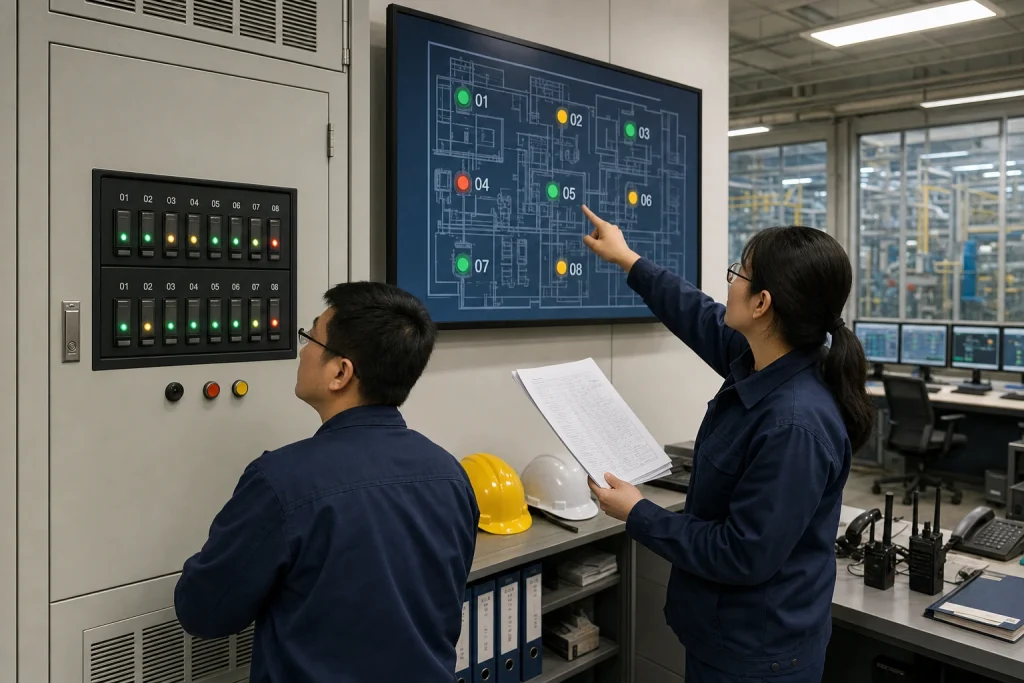
Multi-channel controllers concentrate many measuring points, often organized in groups of channels, into one panel. Each channel is associated with a specific detector and can usually carry its own gas type, measuring range and alarm setpoints. This makes multi-channel systems the natural choice for sites where hazards are distributed: chemical processing units, paint and coating lines, warehouses storing flammable goods, wastewater treatment works and underground utility galleries.
The advantages of consolidation go beyond cable savings:
- Central overview. Operators see the status of an entire site on one display, which shortens response time when an alarm occurs and simplifies shift handover.
- Coordinated outputs. Common relay logic can be considered for site-wide actions, such as starting emergency ventilation when any channel in a defined group reaches its high alarm.
- Simpler maintenance routines. Calibration schedules, fault indications and event review are handled in one place rather than across scattered standalone units.
- Growth headroom. Systems specified with spare channels allow new detectors to be added as processes change, without replacing the panel.
The corresponding considerations are engineering effort and dependency. A multi-channel panel requires more design work up front, including channel mapping, cause-and-effect documentation and structured commissioning. It also concentrates function in one device, so the specification stage should examine power supply arrangements, fault signaling and, where the risk assessment calls for it, redundancy measures.
Key Selection Criteria When Comparing the Two
There is no universally correct answer; the choice follows from the site. The following questions help structure the comparison:
- Number of measuring points, now and later. Count not only current detectors but points likely to be added over the life of the installation. If growth is plausible, a multi-channel controller with spare capacity may be evaluated even for a modest initial scope.
- Geography of the hazards. A single isolated hazard suits a single-zone unit. Hazards spread across several rooms, floors or process areas generally argue for centralization.
- Signal types and gas mix. Confirm that the controller accepts the output signals of the intended detectors and can handle the combination of combustible, toxic and oxygen measuring points on one platform.
- Output and interlock requirements. List every device the system must drive: sounders, beacons, solenoid valves, fans, PLC inputs. The controller must offer enough appropriately rated outputs, with logic that matches the site’s cause-and-effect matrix.
- Operations and maintenance model. Consider who will respond to alarms and where they are stationed. A staffed control room favors a central panel; a small unmanned site may only need local alarm annunciation.
- Documentation and regulatory context. Requirements differ by country and industry, so certification needs, installation standards and inspection regimes should be confirmed for the specific project before the architecture is fixed.
Reviewing typical installation scenarios can also help; our application overview outlines how detection layouts are commonly structured across different industries.
Why ASA
ASA supplies a broad portfolio covering fixed gas detectors, dust monitoring devices and gas alarm controllers in both compact and multi-channel configurations, which allows detector and controller selection to be coordinated within one project. Our engineering team supports customers from point-count reviews and channel planning through to configuration guidance, and our sales engineers respond quickly to technical inquiries from industrial buyers across Europe and the Middle East. If you are weighing a single-zone unit against a multi-channel system for an upcoming project, contact our team for a consultation based on your site layout and gas hazards.
Disclaimer: Product availability, specifications, measuring ranges, alarm configurations and certification coverage vary by model and region. The information in this article is provided for general reference only and does not constitute a performance guarantee, safety assurance or compliance statement. Always refer to the official product documentation and confirm suitability, certification status and local regulatory requirements with our team before selection, installation or use.