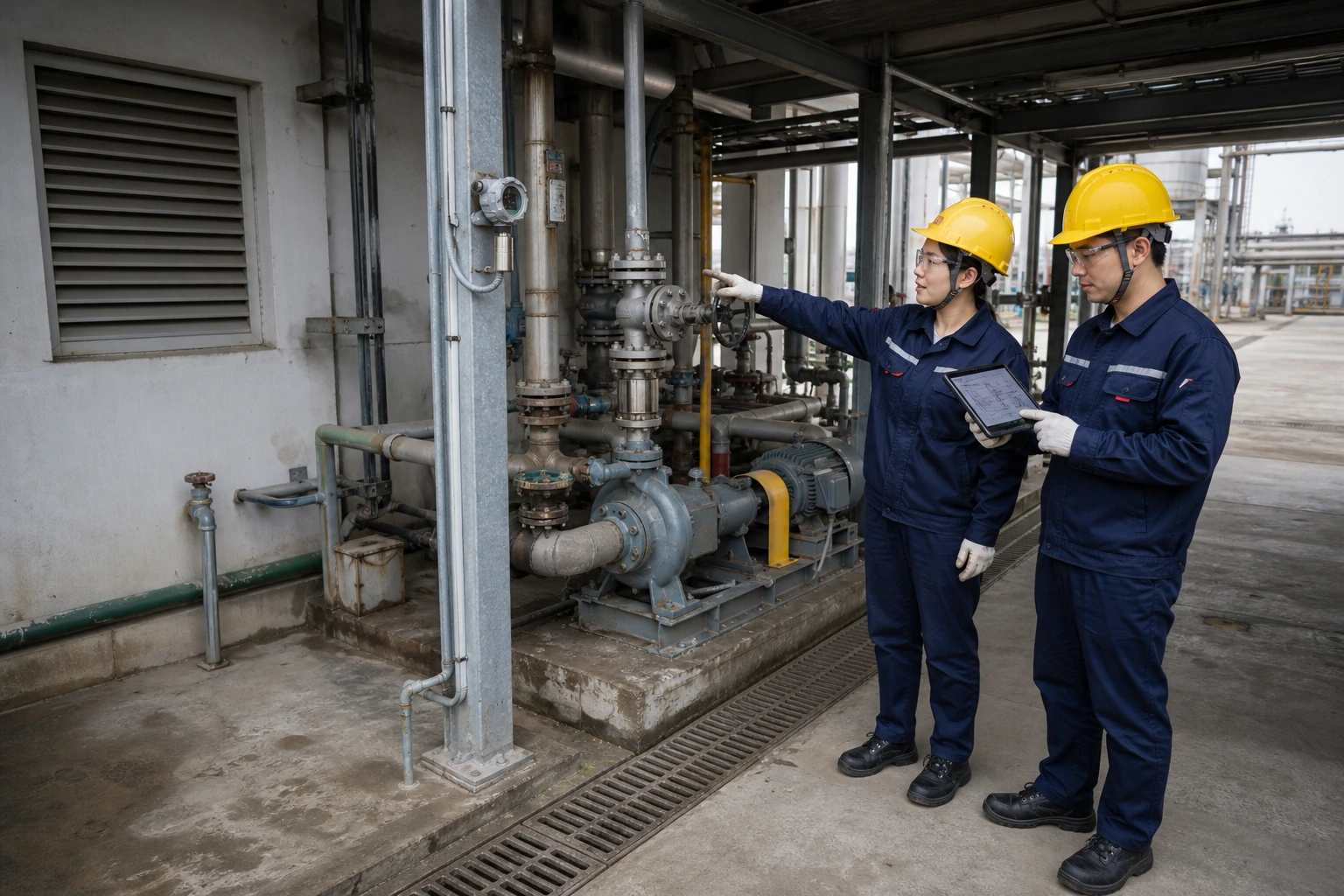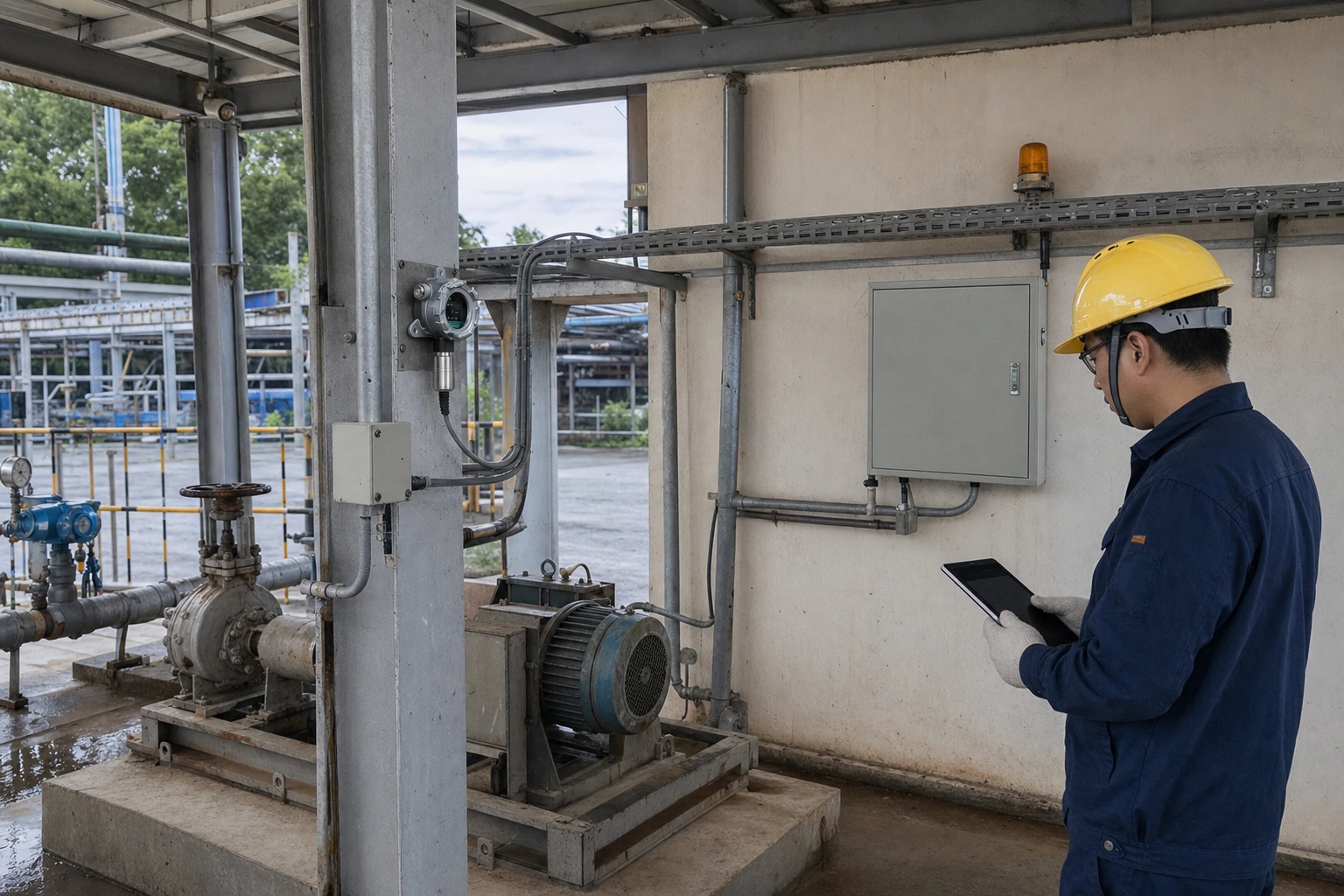
The electrochemical gas sensor remains one of the most widely deployed detection technologies for toxic gases and oxygen in industrial environments, from petrochemical process areas to wastewater treatment plants and confined-space entry work. It responds at low concentrations, draws very little power, and produces an output broadly proportional to gas concentration. What it does not offer is an indefinite service life or immunity from interference. For teams specifying fixed detection, understanding how these cells age, how often they need calibration, and how they behave in mixed-gas atmospheres is central to a monitoring programme that stays reliable between service visits.
How an Electrochemical Cell Detects Gas
An electrochemical sensor is, in essence, a small fuel cell. Target gas diffuses through a porous membrane and a capillary or diffusion barrier into an electrolyte-filled chamber, where it reaches a catalytic working electrode. There the gas is either oxidised or reduced, and the resulting electron transfer is balanced by a complementary reaction at the counter electrode. The current that flows between the two electrodes is proportional to the rate at which gas molecules arrive – which, because the diffusion barrier controls that rate, is proportional to the ambient concentration. A third reference electrode is normally included to hold the working electrode at a stable potential, which improves linearity and helps suppress unwanted reactions.
Sensitivity and selectivity are governed by the choice of catalyst and the working electrode bias, which is why a carbon monoxide cell and a hydrogen sulphide cell can look identical yet behave very differently. This also explains why electrochemical detection is the usual first choice for gases such as CO, H2S, SO2, NH3, Cl2 and NO2, and for oxygen deficiency monitoring, while combustible hydrocarbons are more commonly addressed with catalytic bead or infrared sensing. Where a site needs both toxic and combustible coverage, a mixed sensor population feeding a common alarm panel is the normal arrangement, and the relevant options can be reviewed across our range of fixed gas alarm detectors.
What Determines Sensor Lifespan
Electrochemical cells are consumable. The electrolyte can slowly dry out or absorb water depending on ambient humidity, the catalyst gradually loses activity, and in some chemistries the electrode material itself is consumed by the sensing reaction. Manufacturers commonly quote a service life in the region of two to three years for many toxic gas cells under normal conditions, with traditional lead-based oxygen cells often rated shorter because their anode is consumed continuously whether or not an alarm event ever occurs. These figures are indicative rather than guaranteed, and the actual working life on a given site may be considerably shorter.
Several site conditions accelerate ageing. Sustained high temperature increases electrolyte evaporation and reaction rates. Very low humidity draws moisture out of the cell, while prolonged condensation can flood the diffusion path. Repeated exposure to high gas concentrations – particularly well above the measuring range – consumes reactive material faster and may leave a cell with reduced sensitivity even after it appears to recover. Some gases, notably certain solvents and silicone vapours, can poison or partially inhibit the catalyst. Sensor life on a hot outdoor process unit in a Gulf climate should therefore not be assumed to match that in a temperate indoor plant room, and replacement budgeting can be planned accordingly.
The practical consequence is that a detector may continue to power up and display a stable zero long after it has lost the ability to respond correctly to gas. Zero stability is not evidence of span response; only a challenge with a known test gas can confirm that a cell is still measuring.
Calibration, Bump Testing and Drift
Two distinct procedures are often confused. A bump test applies enough target gas to trigger the alarm and confirms only that gas reaches the sensor and that the alarm chain operates. A full calibration applies certified span gas and adjusts the instrument so its reading matches the known concentration, usually after a fresh zero in clean air. Bump testing is quick and can be performed frequently; calibration takes longer and is what actually corrects drift.
A common approach is frequent bump testing supported by calibration at defined intervals, with the interval tightened where the environment is harsh or the risk is high. Many operators calibrate fixed toxic gas points at least twice yearly and more often during commissioning or after any suspected over-range exposure. Local regulations, insurer requirements and the site’s own risk assessment should set the final schedule, and records should be retained so that drift trends become visible over time. A cell whose span adjustment has moved steadily in one direction across several calibrations is signalling end of life well before it fails outright.
Calibration gas quality matters as much as frequency. Certified mixtures have expiry dates, reactive gases such as chlorine and ammonia can be lost to cylinder walls and tubing over time, and flow rate must suit the sensor’s diffusion path. The correct regulator, adaptor and tubing material is often the difference between a valid calibration and a false pass.
Cross-Sensitivity and Interference
Because detection depends on a catalytic reaction rather than a spectroscopic fingerprint, electrochemical sensors respond to more than one substance. Cross-sensitivity is well documented for common cells: carbon monoxide sensors typically show a response to hydrogen, and may respond to hydrogen sulphide, ethylene or acetylene; hydrogen sulphide cells commonly respond to sulphur dioxide and nitrogen dioxide; and oxidising and reducing gases can produce opposing deflections in the same cell. Interference may be positive, inflating a reading and causing nuisance alarms, or negative, suppressing a reading and masking a genuine hazard – the more dangerous case by far.
Managing this begins at the specification stage. The realistic gas inventory for each monitored area should be established first, including process gases, cleaning chemicals, vehicle exhaust and neighbouring unit emissions. Where an interferent is expected, options that may be evaluated include a filtered sensor variant, a different sensing technology for that point, or a detector layout that separates the interference source from the point of measurement. Alarm strategy can also help: multi-point voting or staged alarm levels configured at a gas alarm controller can be considered where isolated nuisance readings would otherwise trigger costly shutdowns.
Why ASA
ASA supplies fixed gas detectors, dust alarm detectors and multi-channel alarm controllers as a single coordinated product line, allowing toxic, combustible and particulate monitoring points to be brought back to a common alarm architecture rather than assembled from unrelated systems. Our engineering team supports customers in Europe and the Middle East at the selection stage – reviewing gas inventories, sensor technology fit, cross-sensitivity risk and layout – and continues that support through commissioning, spare sensor supply and replacement planning.
If you are specifying or reviewing an electrochemical detection installation, our team can help match sensor technology, ranges and controller configuration to your application. Contact ASA to discuss your requirements.
Disclaimer: Product availability, specifications, measuring ranges, alarm configurations and certification coverage vary by model and region. The information in this article is provided for general reference only and does not constitute a performance guarantee, safety assurance or compliance statement. Always refer to the official product documentation and confirm suitability, certification status and local regulatory requirements with our team before selection, installation or use.