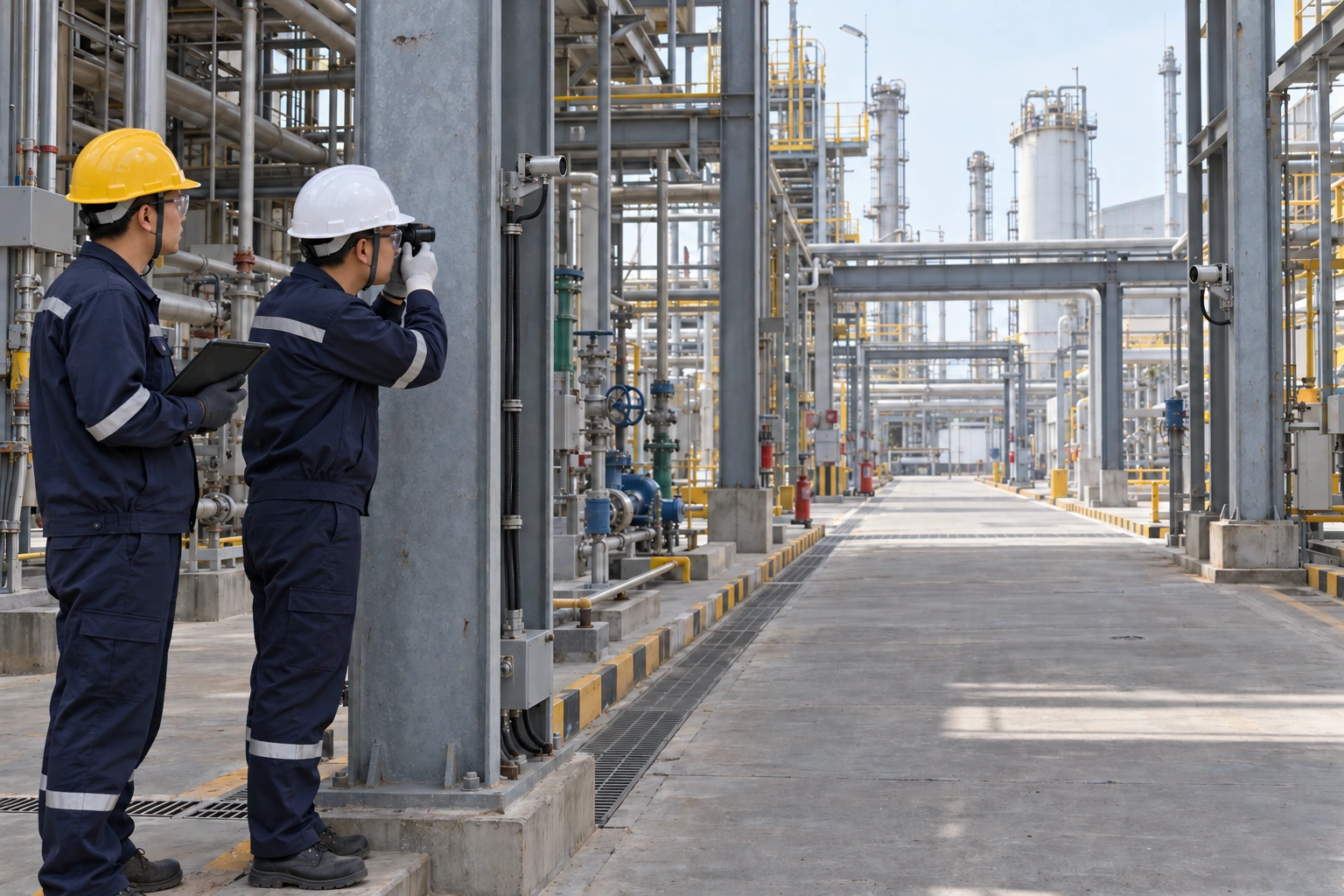
Boiler rooms and gas-fired facilities rely on a continuous supply of natural gas, and that supply is only as safe as the monitoring around it. A correctly specified methane detector boiler room installation gives operators early warning of leaks from valves, joints, burners and supply lines before concentrations approach the flammable range. This article outlines why methane accumulates in these spaces, which properties of the gas shape detector selection and placement, and how fixed detection points are typically integrated with controllers, ventilation and shutdown logic in industrial heating plants.
Why Boiler Rooms Are a Methane Leak Risk
Natural gas used in commercial and industrial boilers is composed mainly of methane (CH4). Inside a boiler room, the gas passes through a chain of components that can each develop leaks over time: isolation valves, pressure regulators, flexible connections, burner trains and pilot lines. Vibration from pumps and fans, thermal cycling, ageing gaskets and mechanical damage during maintenance are all common contributors.
Boiler rooms are often compact, partially enclosed spaces with limited natural airflow, especially in basements or plant rooms of commercial buildings. A small leak that would disperse harmlessly outdoors can build up under the ceiling of an enclosed plant room. Because burners, ignition transformers and electrical switchgear are present in the same space, any accumulation of flammable gas is a serious concern. Fixed gas detection is therefore commonly specified alongside ventilation interlocks and emergency shut-off valves in gas-fired facilities.
Methane Properties That Shape Detection Design
Two well-established properties of methane drive most design decisions in these projects.
First, methane is flammable between its lower explosive limit (LEL) of about 5 percent by volume in air and its upper explosive limit (UEL) of about 15 percent by volume. Fixed detectors for boiler rooms do not wait for these levels; they measure concentration as a percentage of the LEL and are commonly configured to alarm at a low fraction of it, so that action is taken long before the atmosphere can become ignitable.
Second, methane is significantly lighter than air, with a relative density of roughly 0.55. Leaking gas rises and collects at the highest points of the room: under ceilings, in roof voids, above suspended service pipework and near ridge lines. This behaviour is the opposite of heavier-than-air gases such as LPG and directly determines where sensors should be mounted.
Detection technology also matters. Catalytic bead sensors are a long-standing choice for combustible gas monitoring, while infrared sensors can be considered where sensor poisoning or low-oxygen conditions are a concern. Both approaches are widely used for methane, and the right option depends on the environment, maintenance regime and project budget.
Detector Placement in Boiler Rooms and Plant Rooms
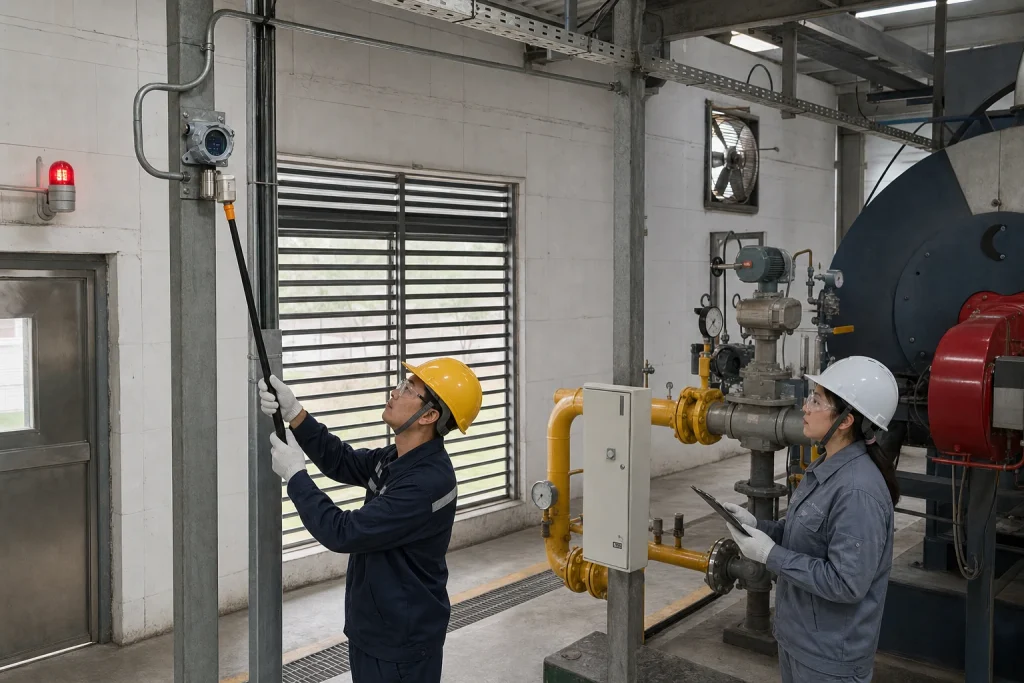
Because methane rises, fixed detectors are generally mounted high in the room, typically near the ceiling above the most likely leak sources such as the gas train, meter set and burner connections. Points to consider during layout include:
- Position sensors above valve groups, regulators and flexible hoses, where leaks most often start.
- Cover ceiling pockets and roof voids where rising gas can be trapped, not only the open ceiling area.
- Keep sensors away from burner exhaust, direct heat and steam plumes that can distort readings or shorten sensor life.
- Account for forced ventilation: airflow from supply and extract fans can carry leaking gas along the ceiling before it reaches a sensor, so placement may be evaluated together with the ventilation design.
- Leave safe access for calibration and response checks, since a detector that cannot be reached tends not to be maintained.
A point-type combustible gas detector such as the AN-LEL-D methane gas alarm detector is a typical building block for this kind of layout, with one transmitter covering a defined zone around each leak source. The AN-LEL-D carries the China Ex Certificate EETI24.0463X (Ex db IIC T6 Gb, IP65), valid to Jan 2030, which supports its use around gas train equipment where a robust, sealed housing is required. The number of points depends on room size, ceiling profile and the spread of gas-carrying equipment; larger boiler houses are usually divided into several detection zones.
Alarm Levels, Controllers and Safety Interlocks
Fixed detectors in a boiler room rarely work alone. Their signals are brought back to a gas detection controller that displays live readings, manages alarm thresholds and drives outputs. A common approach uses two staged alarm levels: a low-level warning that triggers local sounders and increases ventilation, and a high-level alarm that can be wired to close the emergency gas shut-off valve and stop the burners. Exact setpoints are defined by the project engineer in line with local regulations and site risk assessment.
Multi-channel controllers allow a single panel to supervise all detectors in a boiler house and to pass a common alarm to the building management system or fire panel. A unit such as the AN-3100H gas detection controller can be considered for this role, mounted in a control room or corridor, for installation in non-hazardous (safe) areas, with the field detectors located in the boiler room itself. Relay outputs for valves, fans and beacons are the practical link between detection and automatic protection.
Commissioning, Calibration and Ongoing Maintenance
A methane detection system is only trustworthy if it is verified regularly. During commissioning, each detector is typically bump-tested with a known test gas to confirm the reading, and alarm outputs are exercised end to end, from sensor through controller to valve and fan. After handover, a routine of periodic calibration and functional testing is commonly adopted, with intervals set by the manufacturer’s documentation and site policy.
Records matter as much as the tests themselves. Keeping calibration certificates, alarm event logs and maintenance notes in one place helps demonstrate diligence to insurers and inspectors, and makes drift or repeated faults visible early. Operators should also review detector placement whenever the plant changes: a new gas-fired unit, relocated pipework or altered ventilation can shift where leaking gas will travel.
Why ASA
ASA supplies fixed gas detectors, dust monitors and gas alarm controllers for industrial customers across Europe and the Middle East. For boiler rooms and gas-fired plants, that means a product line that covers combustible gas detection points and multi-channel controllers from one source, engineering support to help you plan detector counts and placement for your specific room, and responsive communication from enquiry through after-sales. If you are specifying or upgrading methane detection for a boiler house, our team can review your layout and recommend a workable configuration. Contact ASA to discuss your project.
Disclaimer: Product availability, specifications, measuring ranges, alarm configurations and certification coverage vary by model and region. The information in this article is provided for general reference only and does not constitute a performance guarantee, safety assurance or compliance statement. Always refer to the official product documentation and confirm suitability, certification status and local regulatory requirements with our team before selection, installation or use.