
A sampling vs diffusion detector comparison starts with one practical question: where must the gas be measured, and where can the instrument be installed and maintained? Diffusion detectors measure gas reaching their local sensing inlet. Pump-draw systems transport a sample from another location to the sensor. For industrial buyers in Europe and the Middle East, the choice should follow the site hazard assessment, access constraints and maintenance capability. A pump introduces a sample path that must be specified and verified alongside the detector.
What Changes Between Diffusion and Pump-Draw Detection?
In a diffusion arrangement, the detector is positioned at the intended monitoring point, with its inlet exposed according to the manufacturer’s instructions. A pumped arrangement separates the sampling inlet from the measuring instrument. Neither arrangement measures every part of a room simply because it is operating. Industrial Scientific’s explanation of diffusion and pumped monitoring makes this distinction clear: detection depends on gas reaching the sensor or sampling inlet.
This means that adding a pump does not correct an unsuitable monitoring location. Both approaches require an assessment of potential release points, ventilation, obstructions and operating conditions. A sampling inlet outside the likely gas path can miss a release, just as a poorly positioned diffusion detector can. Location selection should therefore precede the decision about how the sample reaches the sensor.
Diffusion is commonly used where a detector can be mounted at a representative location and reached for service. Buyers comparing fixed gas alarm detectors should first define the monitoring task, then establish whether the proposed model and installation method suit it.
When a Pump-Draw System May Be Evaluated
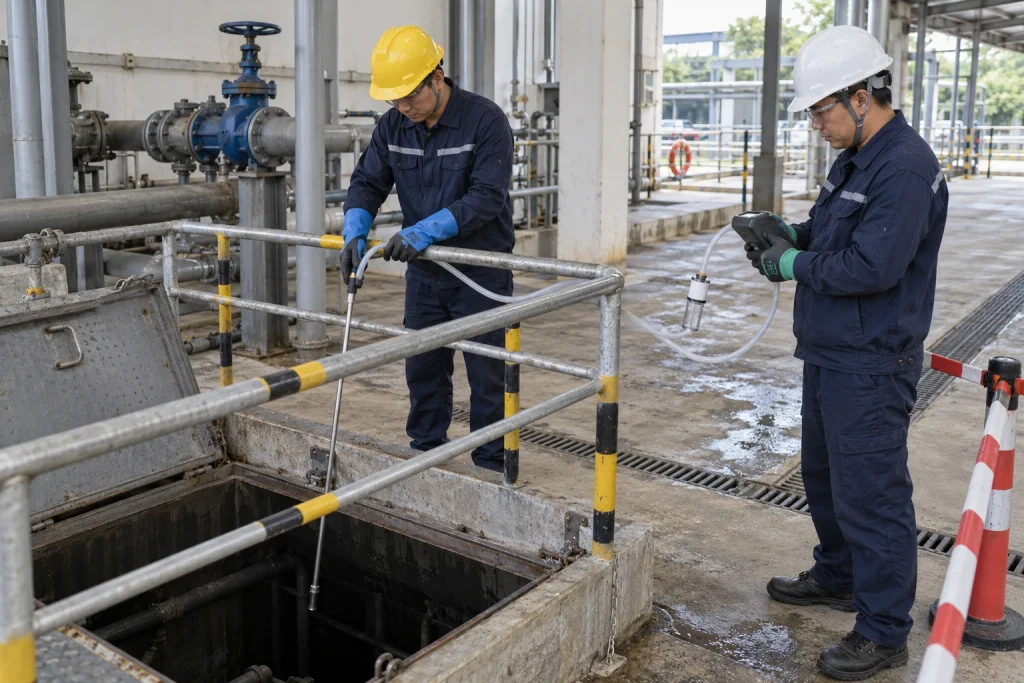
Remote sampling may be evaluated when the intended measurement point is difficult to access but the instrument needs regular inspection. Examples include selected equipment enclosures, enclosed plant spaces and locations where direct mounting creates a maintenance problem. The sampling probe still needs inspection and service access. Moving the instrument does not eliminate work at the measurement point.
Another possible reason is to keep the measuring instrument in a more suitable environment while taking a sample from the monitored location. This requires a designed sampling arrangement. Sample temperature, moisture and pressure must remain compatible with the equipment, and any conditioning must preserve the substance being measured. A filter or cooler that removes part of the target gas can undermine the measurement.
Buyers should distinguish continuous fixed monitoring from occasional remote checks with a portable instrument. A portable sampling procedure does not establish that a fixed system will provide the required continuous coverage. Where several points share one analyzer, the specification should address the sequence, time spent at each point and interval before a point is measured again. These gaps matter when conditions can change quickly.
Specify the Complete Sample Path
The sample path includes the inlet, tubing, fittings, filters, pump and any conditioning components. Their compatibility should be confirmed as an assembly for the target gas and expected environment. Do not assume that a tube suitable for one measurement is suitable for every other gas. The supplier should identify permitted materials and explain restrictions affecting the proposed installation.
Timing must also be considered from inlet to alarm. Gas transport adds delay before the sensor can respond, and longer tubing requires attention to the actual flow through the installed arrangement. Industrial Scientific’s remote sampling guidance highlights both sample travel time and the possibility of gas loss in unsuitable tubing. Use the selected equipment’s instructions and project verification rather than adopting another monitor’s waiting-time rule.
Specify how loss of sample flow will be detected and reported. A blocked inlet, failed pump or disconnected line should not leave operators relying on an apparently normal concentration reading. Ask how the proposed equipment distinguishes measurement alarms from sampling faults and what the operating procedure requires after either condition. The exact response should be agreed with the responsible site engineers.
Finally, define the sample discharge route. Extracted gas needs an appropriate destination, particularly if the measuring equipment is located in an occupied area. The proposed routing should be reviewed for the substances involved and should follow the manufacturer’s installation requirements.
Compare Maintenance and Acceptance Requirements
Procurement comparisons should include the work needed to keep each arrangement functional. A diffusion installation requires access to the detector and its inlet. A pumped installation adds inspection of sample lines, connections, filters and the pump. Request a maintenance schedule, a consumables list and clear instructions for checking sample integrity. These requirements should be reflected in the site’s available personnel and service access.
Before accepting a system, agree how the installed measurement chain will be demonstrated. A check at the sensor alone does not establish that gas can travel successfully from a remote inlet. Where permitted by the manufacturer’s procedure, testing through the sample inlet can help assess the complete path. Record the configuration and observed behavior so future maintenance has a useful reference.
The quotation should also identify responsibility for selecting monitoring points, designing sampling lines, configuring alarms and commissioning the installation. Confirm the required documentation for the destination market without assuming that a general product description establishes project suitability. A clear division of responsibilities helps buyers compare proposals on an equivalent basis.
Why ASA
ASA’s product scope includes gas detectors, dust alarm detectors and gas alarm controllers. For an industrial purchasing team, this provides a starting point for discussing detection and alarm requirements across a project. Engineering discussions should begin with the target hazard, monitoring locations and intended operating procedure, followed by confirmation of the relevant model documentation.
For a sampling proposal, ask ASA to confirm available equipment, compatibility requirements and the scope of engineering support before purchase. Include a location sketch, expected environmental conditions and maintenance constraints in the inquiry, and request the response and delivery schedule your project needs. Contact ASA to discuss your detection requirements and establish whether diffusion monitoring or a documented pump-draw arrangement may be considered.
Disclaimer: Product availability, specifications, measuring ranges, alarm configurations and certification coverage vary by model and region. The information in this article is provided for general reference only and does not constitute a performance guarantee, safety assurance or compliance statement. Always refer to the official product documentation and confirm suitability, certification status and local regulatory requirements with our team before selection, installation or use.