
Battery and lithium cell plants combine flammable solvents, reactive cell chemistry and tightly controlled process atmospheres in a way that few other manufacturing environments do. A well-planned gas detection battery manufacturing strategy is therefore not an optional extra but a core part of process safety design, protecting operators, equipment and production continuity from electrode coating through to formation, aging and pack assembly. This article walks through the main gas hazards found along a typical lithium cell production line and outlines how fixed detection points are commonly arranged to cover them.
Where Gas Hazards Appear Along the Cell Production Line
Each stage of lithium cell manufacturing introduces its own gas risk profile. In electrode preparation, cathode slurries are often mixed with organic solvents, and solvent vapor is released during coating and drying. Electrolyte filling brings volatile carbonate solvents such as dimethyl carbonate (DMC) and ethyl methyl carbonate (EMC) into the workspace, all of which are flammable. During formation and aging, cells are charged for the first time, and defective cells can vent gas mixtures that include hydrogen and carbon monoxide. Finally, warehouses and test areas holding finished cells carry a thermal runaway risk, where a single failing cell can release a large volume of flammable and toxic off-gas in a short time.
Because these hazards differ by area, a single detector type rarely covers a whole plant. Most sites end up with a mixed layout: combustible gas monitoring in %LEL where solvent vapor or hydrogen may accumulate, ppm-level toxic and VOC monitoring in work areas, and oxygen monitoring wherever inert gas or dry-room atmospheres are used.
Solvent Vapors in Coating, Drying and Electrolyte Filling
The coating and drying section is usually the largest single source of solvent vapor in a battery plant. N-Methyl-2-pyrrolidone (NMP), widely used as a cathode slurry solvent, is combustible and is also subject to increasingly strict occupational exposure regulation in Europe, so many plants monitor it both as a fire risk and as a health concern. Electrolyte filling stations release carbonate solvent vapors that are flammable and heavier than air, meaning they can pool at low points and inside enclosed machine cabinets.
For ppm-level monitoring of solvent vapors in occupied areas, photoionization detection is commonly used because it responds to a broad range of organic compounds at low concentrations. A fixed PID VOC gas detector positioned near coating heads, solvent recovery equipment or electrolyte filling stations can be considered as a way to flag rising vapor levels before they approach flammable concentrations. For enclosed drying ovens and solvent recovery loops, %LEL combustible gas monitoring is typically applied in addition, since the priority there is explosion prevention rather than exposure control.
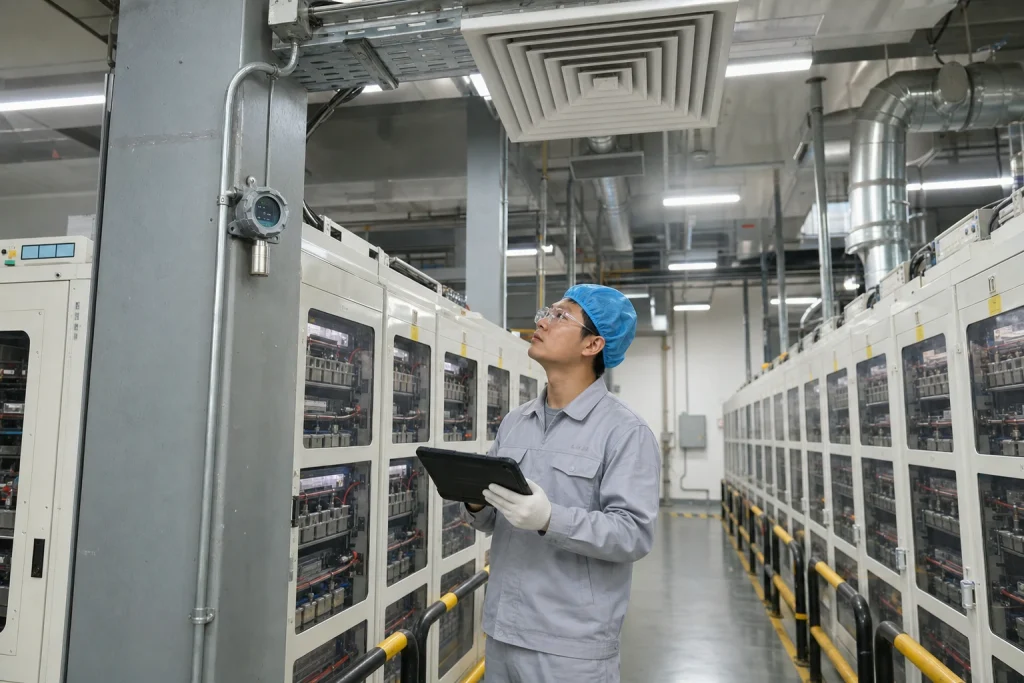
Hydrogen and Off-Gas Risks in Formation and Aging
Formation and aging halls hold thousands of cells under charge at any one time, and this is where gas detection layouts deserve particular attention. Hydrogen has a lower explosive limit of 4 percent by volume and is much lighter than air, so it rises quickly and can accumulate under ceilings, in cable trays and inside enclosed formation towers. Detection points for hydrogen-rich atmospheres are therefore commonly placed at high level above the racks rather than at breathing height.
When a cell fails during formation or storage, the vented gas is typically a mixture that can include hydrogen, carbon monoxide, carbon dioxide and vaporized electrolyte. Carbon monoxide monitoring is often added in formation and aging areas for this reason: CO is both toxic at low ppm concentrations and an early chemical signature of cell venting. Some sites also evaluate off-gas monitoring inside battery test chambers and storage racks so that a venting event can trigger alarms before visible smoke appears.
Oxygen Monitoring in Dry Rooms and Inerted Areas
Dry rooms and glove-box lines are a defining feature of lithium cell production, and some process steps use nitrogen or other inert gas to protect moisture- and oxygen-sensitive materials. Wherever inert gas is piped into an enclosed, occupied space, oxygen depletion becomes a credible hazard: a leak can quietly displace breathable air without any odor or visible warning. Atmospheres below 19.5 percent oxygen are widely treated as oxygen deficient in occupational safety practice, compared with the normal 20.9 percent.
Fixed oxygen monitoring at breathing height near inert gas usage points, dry-room entrances and low-ventilation corners is a common safeguard. A dedicated fixed oxygen O2 gas detector may be evaluated for these locations so that personnel are warned before entering or remaining in a depleted atmosphere. Where nitrogen generators or bulk storage sit close to production, the surrounding rooms and pits can be considered for coverage as well.
Building the Detection Layout: Points, Alarms and Control
A practical layout usually starts with a walk-through of the process: map solvent release points, hydrogen accumulation zones, inert gas usage and storage areas for finished cells, then assign detector types and mounting heights accordingly. Heavier-than-air solvent vapors call for low-level mounting near potential release points; hydrogen calls for high-level coverage; oxygen and toxic monitoring belongs at breathing height in occupied zones.
Individual detectors are then wired back to a central alarm system so that maintenance and emergency teams see the whole plant at a glance. Multi-channel controllers can group detectors by production area, drive local sounders and beacons, and pass signals to ventilation or shutdown logic. An overview of available system options can be found in our gas alarm controller range. Alarm setpoints, response actions and testing intervals should always be defined together with the site safety team and aligned with local regulations and the plant risk assessment.
Why ASA
ASA supplies fixed gas detectors, dust monitors and alarm controllers covering combustible, toxic, VOC and oxygen measurement needs across industrial sites, which allows battery manufacturers to source a coherent detection package from one supplier. Our engineering team supports customers from detector selection and placement review through to output configuration and commissioning guidance, and responds quickly to technical questions from projects in Europe and the Middle East. If you are planning gas detection for a battery or lithium cell facility, contact our team to discuss your production layout and monitoring requirements.
Disclaimer: Product availability, specifications, measuring ranges, alarm configurations and certification coverage vary by model and region. The information in this article is provided for general reference only and does not constitute a performance guarantee, safety assurance or compliance statement. Always refer to the official product documentation and confirm suitability, certification status and local regulatory requirements with our team before selection, installation or use.