
Fires in production plants and warehouses rarely start as open flames. Far more often they begin as a slow, smoldering process inside cable trays, electrical cabinets, storage racking or dust deposits, releasing smoke long before significant heat develops. An industrial smoke detector is designed to catch this early stage, giving operators and fire teams the minutes they need to intervene before a small fault becomes a facility-level loss. For safety and procurement engineers, the key questions are which sensing technology suits the environment, where detectors should be placed in large or high-ceiling buildings, and how smoke detection fits alongside heat and gas monitoring in an overall protection concept.
How Industrial Smoke Detectors Work
Most smoke detectors used in industrial buildings rely on optical (photoelectric) sensing. A light source inside the detection chamber is scattered by smoke particles entering the chamber, and the detector triggers when scattered light exceeds a set threshold. Optical detectors are commonly used for the smoldering fires typical of electrical faults and stored combustible materials, because these fires produce relatively large, visible smoke particles at an early stage.
Other technologies can be considered for specific building geometries. Beam detectors project a light beam across a large open space and respond to smoke that obscures the beam, which makes them a practical option for warehouses with high ceilings and long aisles. Aspirating smoke detection systems continuously draw air through a pipe network to a central sensing unit and may be evaluated where very early warning is required or where detectors cannot easily be mounted at ceiling level. Each approach has trade-offs in coverage, sensitivity and maintenance effort, so the choice is normally driven by the building layout and the fire risks identified in the site assessment.
Why Plants and Warehouses Need Early Warning
Industrial buildings concentrate three factors that make early detection valuable. First, fire loads are high: packaging materials, plastics, solvents, cable runs and stored goods can sustain rapid fire growth once ignition occurs. Second, spaces are large and often sparsely occupied, especially at night or in automated storage areas, so a fire may burn unnoticed for a long time if there is no automatic detection. Third, the consequences extend beyond the immediate damage, since smoke contamination of stock and production equipment, and the downtime that follows, are frequently more costly than the fire itself.
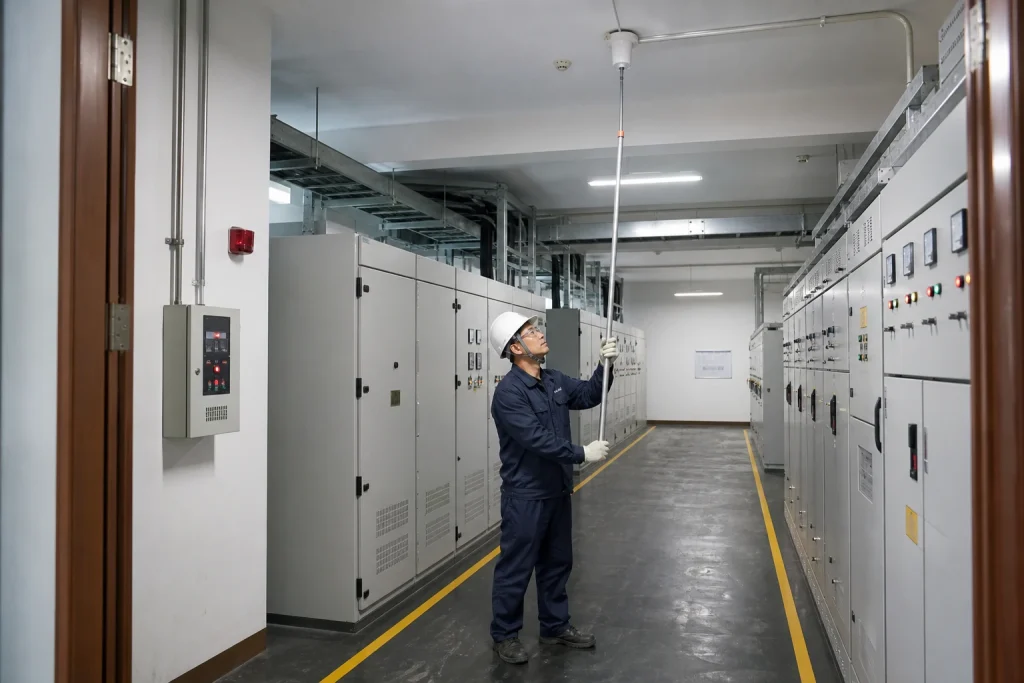
Typical areas where smoke detection is commonly prioritized include electrical rooms and switchgear cabinets, server and control rooms, battery charging areas, cable tunnels, conveyor transfer points and high-bay racking. In many of these locations a smoldering fault can develop for hours, which is exactly the scenario early-warning smoke detection is intended to address.
Choosing Detection for Harsh Industrial Conditions
Standard commercial smoke detectors are designed for clean indoor air, and industrial environments can challenge them. Dust, water vapor, exhaust aerosols and temperature extremes may cause nuisance alarms or, worse, gradual sensor contamination that reduces sensitivity. When specifying an industrial smoke detector, it is worth reviewing the expected ambient conditions in detail: typical dust levels, humidity, temperature range, air velocity from ventilation systems, and any process emissions that resemble smoke.
Practical measures can include selecting detectors with better ingress protection, using sampling-based systems with filters in dusty areas, relocating detection points away from steam or exhaust sources, and defining a maintenance schedule that keeps chambers clean. Where an area regularly produces airborne particles as part of the process, heat detection or temperature monitoring is commonly used instead of, or in addition to, smoke sensing, since it is far less affected by dust. A dedicated temperature monitoring point such as a fixed temperature alarm can be considered for plant rooms, enclosures and other locations where smoke detectors would face constant nuisance sources.
Combining Smoke, Heat and Gas Detection
Smoke detection answers one question: is something burning. Many industrial fire scenarios also involve gases that either precede the fire or accompany it. Carbon monoxide is produced by incomplete combustion and tends to appear early in smoldering fires, so CO monitoring with a fixed carbon monoxide gas detector may be evaluated as a complementary early indicator in enclosed areas such as basements, tunnels and storage rooms. Where flammable gases or solvent vapors are present, combustible gas detection addresses the risk of an explosive atmosphere forming before any ignition, which smoke detectors cannot see at all.
A layered concept therefore often combines smoke detectors for general fire cover, heat or temperature alarms for dirty or humid areas, and gas detectors for specific chemical risks, all reporting to the site alarm and control infrastructure. Examples of how these layers are applied across different industries are collected on our applications overview. When planning outputs, most fixed detectors and alarms provide relay contacts or standard industrial signals, which allows fire and gas events to trigger ventilation, shutdowns or notification through the same control path.
Installation and Maintenance Basics
Placement follows the behavior of smoke: it rises with the fire plume and spreads along the ceiling. Detectors are therefore normally ceiling-mounted, with spacing reduced where beams, racking or ventilation patterns interrupt smoke travel. In very high buildings, smoke can cool and stratify before reaching the ceiling, which is one reason beam or aspirating systems are commonly considered for tall warehouses. Local fire codes and the guidance of the responsible fire authority define the detailed spacing and zoning requirements for each project, and these should always take precedence over generic rules of thumb.
Maintenance is not optional in industrial air. A reasonable program includes periodic visual inspection, functional testing with test aerosol or the manufacturer’s prescribed method, cleaning or replacement of contaminated detectors, and record keeping for audits and insurers. Sites that track nuisance alarms systematically can often trace them to a few specific locations and resolve the root cause rather than silencing detectors, which is a practice that has contributed to serious losses in the past.
Why ASA
ASA supplies fixed detection equipment for industrial safety applications, with a product line that covers gas detectors for toxic, combustible and oxygen risks, dust concentration monitors, temperature alarms and multi-channel alarm controllers. Our engineering team supports customers in Europe and the Middle East with product selection, signal integration and layout questions, and responds quickly to technical inquiries during specification and after delivery. If you are planning fire and gas monitoring for a plant or warehouse and want to discuss which detection layers fit your site, contact our team for a consultation.
Disclaimer: Product availability, specifications, measuring ranges, alarm configurations and certification coverage vary by model and region. The information in this article is provided for general reference only and does not constitute a performance guarantee, safety assurance or compliance statement. Always refer to the official product documentation and confirm suitability, certification status and local regulatory requirements with our team before selection, installation or use.