
Buyers who specify fixed or portable oxygen monitors for European projects sooner or later run into the EN 50104 oxygen detection standard. It is the European performance standard that defines how electrical apparatus for the detection and measurement of oxygen should behave and how it should be tested. Understanding what the standard actually covers, and what it does not, helps procurement and EHS teams write cleaner specifications, compare supplier claims on equal terms, and avoid paying for features that a given application does not require. This guide summarizes the scope of EN 50104, the main performance requirements it addresses, and the practical questions worth asking before a purchase order is placed.
What Is EN 50104 and Where Does It Sit Among Gas Detection Standards?
European gas detection performance standards are split by gas type. Apparatus for combustible gases is generally addressed by the EN 60079-29 series, apparatus for toxic gases by EN 45544, and apparatus for oxygen by EN 50104. The current edition of EN 50104 was published in 2019, replacing the earlier 2010 edition.
It is important to distinguish performance standards from explosion protection standards. EN 50104 deals with how well an instrument measures oxygen: accuracy, response time, stability, alarm behavior and environmental robustness. It does not by itself make an instrument suitable for use in a hazardous (potentially explosive) area; that suitability is covered by separate explosion protection certification schemes. A complete specification for an oxygen monitor in a classified area therefore typically references both a performance requirement and an explosion protection requirement, and the two should not be confused or merged.
Scope: Oxygen Deficiency, Oxygen Enrichment and Inerting
EN 50104 covers apparatus intended to measure oxygen concentration in air and in other gas mixtures, and it addresses both directions of risk:
- Oxygen deficiency. Normal ambient air contains about 20.9 percent oxygen by volume. When oxygen is displaced by nitrogen, argon, carbon dioxide or other gases, the atmosphere can become unable to support life. A commonly used alarm level for oxygen deficiency in industrial practice is 19.5 percent by volume, which is also the threshold below which many regulators consider an atmosphere oxygen deficient.
- Oxygen enrichment. Atmospheres with elevated oxygen dramatically increase fire risk: materials ignite more easily and burn more intensely. Enrichment alarms are commonly set in the region of 23 to 23.5 percent by volume in industrial practice.
- Inerting applications. The standard also addresses oxygen measurement where the process goal is to keep oxygen low on purpose, for example blanketing tanks or process vessels with nitrogen. Here the measurement task is to confirm that oxygen stays below a defined limit rather than to protect breathing air.
The standard applies to both fixed installations and portable or transportable apparatus, which is why it appears in specifications for permanently installed monitors in plant rooms as well as for personal and area monitors used in confined space entry.
Key Performance Requirements and Test Methods
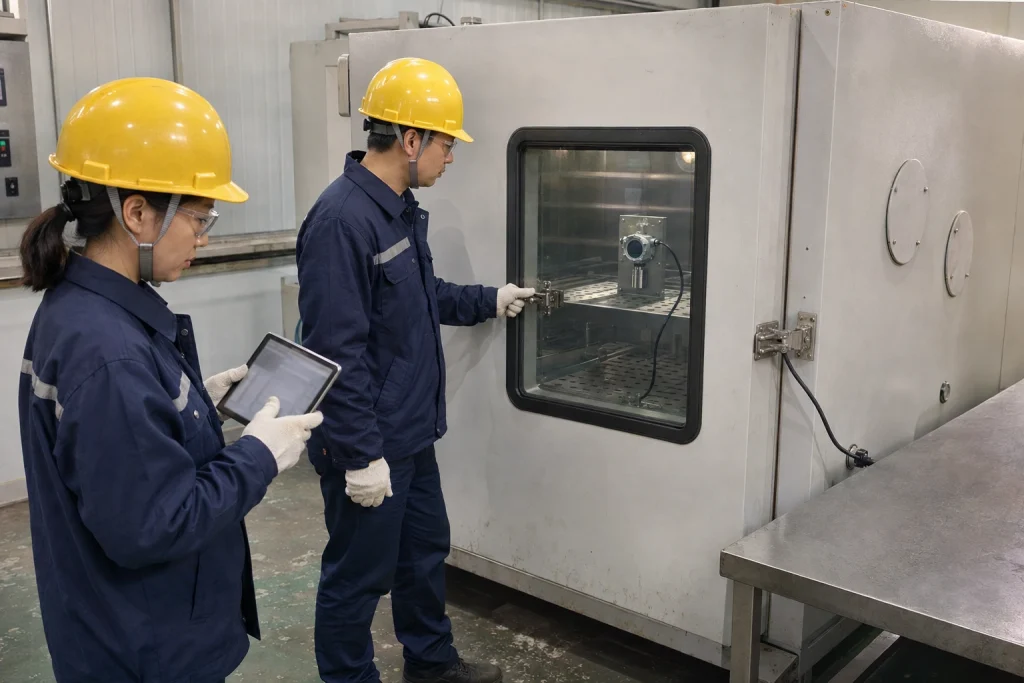
EN 50104 defines laboratory test methods and acceptance criteria across a range of conditions that reflect real service. While the exact numerical limits depend on the apparatus type and measuring range and should always be read from the standard itself, the categories of testing give buyers a useful checklist of what a conforming instrument has been challenged on:
- Calibration and measurement accuracy. The indication must stay within defined tolerances under reference conditions and after exposure to test gases.
- Response time. The time for the reading to reach a defined fraction of a step change, commonly expressed as t90, is measured so that users know how quickly the instrument reacts to a changing atmosphere.
- Alarm set point behavior. For apparatus with alarm functions, the standard addresses the accuracy and repeatability of alarm activation, which is what safety systems ultimately depend on.
- Environmental influences. Tests cover variations in temperature, pressure and humidity, since oxygen sensors can be sensitive to all three.
- Long-term stability and drift. The instrument is operated over an extended period to check that the reading does not wander beyond acceptable limits between calibrations.
- Mechanical and electrical robustness. Vibration, orientation and electromagnetic compatibility are addressed, the latter typically by reference to the gas detection EMC standard EN 50270.
For buyers, the practical value of this list is that it turns a vague requirement such as “reliable oxygen monitor” into concrete, testable questions: what is the documented t90, what drift is expected over the calibration interval, and how does the instrument behave at the temperature extremes of the installation site?
What EN 50104 Means When Specifying Oxygen Detectors
When a project specification calls for EN 50104, ask the supplier for test documentation from an identified laboratory, and confirm which edition of the standard the testing refers to. If a project does not formally require the standard, its structure is still a sensible template for comparing instruments: measuring range, response time, alarm accuracy, environmental limits and drift are the parameters that determine how an oxygen monitor performs in service regardless of the paperwork behind it.
Typical applications where fixed oxygen monitoring may be evaluated include nitrogen and argon storage areas, cryogenic plants, laboratories, battery rooms, breweries and beverage cellars using carbon dioxide, and confined or poorly ventilated technical spaces. For continuous supervision of such areas, a fixed oxygen O2 gas detector such as the ASA AN-O2-D can be considered; it carries the China Ex Certificate EETI24.0463X (Ex db IIC T6 Gb, IP65), valid to Jan 2030. Where a wider monitoring scheme covering several gases is being planned, it is often more efficient to review the full range of gas alarm detectors together so that transmitters, controllers and alarm philosophy stay consistent across the site.
Two practical reminders. First, alarm set points should follow the site risk assessment and local regulations, not only supplier defaults. Second, oxygen sensors have finite service lives and calibration needs, so the maintenance plan is as much a part of compliance as the initial purchase.
Why ASA
ASA supplies fixed gas detectors, dust alarm detectors and gas alarm controllers for industrial buyers across Europe and the Middle East. Our product line covers oxygen, toxic and combustible gas monitoring from a single source, which simplifies specification and spare parts management. Our engineering team supports detector selection, sensor placement review and controller configuration, and we respond quickly to technical enquiries during both the tendering and installation phases. If you are preparing an oxygen monitoring specification and want to discuss measuring ranges, alarm levels or documentation requirements, contact our team for a prompt technical response.
Disclaimer: Product availability, specifications, measuring ranges, alarm configurations and certification coverage vary by model and region. The information in this article is provided for general reference only and does not constitute a performance guarantee, safety assurance or compliance statement. Always refer to the official product documentation and confirm suitability, certification status and local regulatory requirements with our team before selection, installation or use.