Summer conditions across the Gulf put industrial instrumentation under sustained stress that temperate-climate specifications rarely anticipate. Planning high temperature gas detection for refineries, petrochemical plants, water treatment works and utility sites in the region means looking beyond the gas list and the detection principle, and considering how heat, solar load, humidity and airborne dust act on sensors, enclosures, cabling and maintenance routines over the whole service life of the system.
What High Ambient Heat Actually Does to a Detector
Every gas sensing technology has a specified operating temperature range, and behaviour near the upper end of that range is rarely linear. Three effects matter most for fixed installations in hot climates.
Accelerated ageing. Electrochemical cells rely on a liquid electrolyte. At elevated temperatures the electrolyte can lose water more quickly, particularly when ambient humidity is low, which tends to shorten usable sensor life compared with the same cell running in a mild climate. Operators often find that replacement intervals quoted in generic datasheets need to be treated as an upper bound rather than a plan.
Baseline and span drift. Sensor output usually carries some temperature dependence. Manufacturers compensate for this in the detector electronics, but compensation is characterised over a defined range, and drift may increase once conditions sit persistently at the top of that range or swing widely between day and night.
Thermal load on electronics. The sensing element is not the only concern. Displays, transmitters and power supplies inside a detector housing have their own limits, and an enclosure in direct sun can run substantially hotter than the shaded air temperature measured nearby. Sizing a system to the published regional air temperature alone can understate what the equipment actually sees on a south-facing structure at midday.
Selecting Sensing Technology for Hot Sites
No single detection principle is correct for every point, and technology choice should still follow the target gas and the risk. Heat simply changes the weighting between otherwise valid options.
Infrared detection is commonly used for carbon dioxide and for hydrocarbon gases in environments where a long, stable service interval is a priority, since the measurement does not consume a reagent and is not poisoned by common process contaminants. An NDIR-based fixed CO2 gas detector may be considered where continuous monitoring is required and frequent site visits are impractical.
Catalytic bead detection remains widely applied for flammable gases and vapours measured as a percentage of the lower explosive limit. It is well understood and cost effective, but the element is sensitive to poisoning and to oxygen-deficient conditions, so hot and contaminated locations deserve a realistic bump test schedule. For methane and similar flammables, a fixed combustible gas detector can be evaluated against the specific vapours present. The ASA AN-LEL-D carries China Ex Certificate EETI24.0463X (Ex db IIC T6 Gb, IP65), valid to Jan 2030; note that an explosion protection marking describes the protection concept and temperature classification rather than a guarantee of performance at any ambient temperature, so the permitted operating range should always be confirmed from the product documentation for the site in question.
Electrochemical detection is still the practical answer for many toxic gases, including hydrogen sulphide, carbon monoxide and ammonia. The design response to heat is usually not to abandon the technology, but to protect the installation and plan for shorter sensor life.
Installation Details That Make the Difference
Much of what determines whether a system survives a Gulf summer is decided during detailed design rather than during product selection.
- Shade the housing. Sun shields or weather hoods reduce direct solar gain on the enclosure and can keep internal temperature meaningfully closer to ambient. Where layout allows, mounting on a shaded elevation or under existing structure is preferable to adding hardware.
- Respect gas density, then micro-climate. Mounting height should follow the vapour density of the target gas and the ventilation pattern, but among otherwise equivalent positions the cooler and less dust-exposed one is worth choosing.
- Plan for dust and sand. Ingress protection ratings and sinter or splash guard condition deserve attention, because a partially blocked sensor path slows response long before it produces an obvious fault. Inspection of guards can be built into routine rounds.
- Watch overnight condensation. Coastal sites can swing from very hot days to humid nights, and moisture forming inside enclosures is a common cause of terminal corrosion. Correct gland selection, cable entry orientation and breather arrangements matter.
- Keep the panel cool. Controllers are generally best located in an air-conditioned control room or a shaded, ventilated equipment room. The ASA AN-3100H gas detection controller is intended for installation in non-hazardous (safe) areas, which usually aligns well with this approach.
Calibration, Maintenance and Spares Strategy
A hot-climate system is typically maintained more actively than the same system in a mild climate. Calibration intervals set by a generic corporate standard may need to be tightened after the first year of trend data, and bump testing is a low-cost way to catch a degraded sensor between full calibrations.
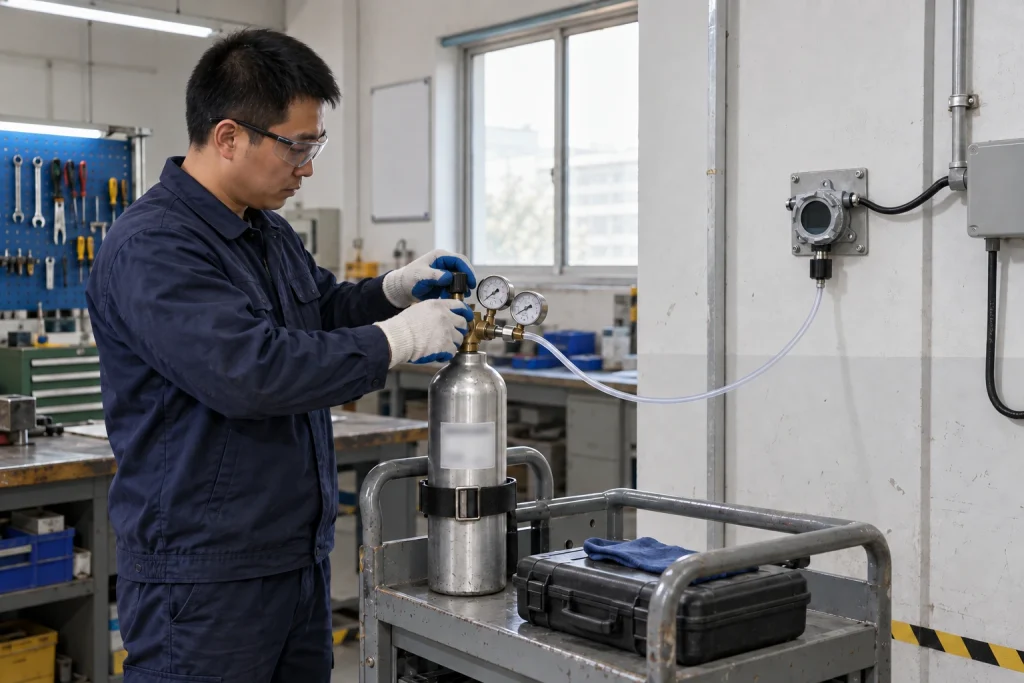
Calibration gas itself needs shaded, temperature-controlled storage, since cylinder pressure and mixture stability are affected by heat. Field calibration is best carried out in the cooler part of the day where operationally possible, so that the detector is not being adjusted at an extreme of its compensation range.
Spares planning deserves equal attention. If sensor life is shortened by the environment, lead times for replacement cells become part of the availability calculation. Holding a modest stock of the most heat-exposed sensor types is often more economical than repeated expedited shipping. For a broader view of the detector families that can be combined into one site-wide system, our gas alarm detector range shows the fixed monitoring options available.
Why ASA
ASA supplies fixed gas detectors, dust alarm detectors and gas alarm controllers to industrial users in Europe and the Middle East, covering flammable, toxic and asphyxiant risks from a single product line. Our engineers can help review detector selection, mounting arrangements and maintenance planning for hot and dusty sites, and we aim to respond quickly to technical and commercial enquiries so that project schedules are not held up. To discuss a Gulf region project or an upgrade to an existing installation, contact the ASA team.
Disclaimer: Product availability, specifications, measuring ranges, alarm configurations and certification coverage vary by model and region. The information in this article is provided for general reference only and does not constitute a performance guarantee, safety assurance or compliance statement. Always refer to the official product documentation and confirm suitability, certification status and local regulatory requirements with our team before selection, installation or use.