
Effective dust alarm selection starts with the powder, the process and the decision an alarm must support. A detector used to identify a leaking filter has a different job from an instrument tracking airborne dust near a bagging station. For industrial buyers in Europe and the Middle East, comparing sensor types is only useful after these objectives are clear. The purchasing specification should connect material properties, installation conditions and operator actions, rather than treating every dust reading as an equivalent measure of risk.
Define the Powder Hazard and Monitoring Objective
Start by identifying the material and how processing changes it. Record the powder composition, expected particle sizes, moisture, handling temperature and whether different products pass through the same equipment. Grinding, drying and blending may change the characteristics of the dust reaching a sensor. Information for a bulk ingredient may therefore be insufficient for evaluating the fine material collected downstream.
Combustible dust assessment requires particular care. Ignition and explosion behavior depend on material and physical conditions; a powder name alone does not establish its hazard. Representative testing may be needed where relevant properties are unknown. OSHA’s hazard classification guidance describes how particle size, moisture and other characteristics influence dust explosibility. Use such guidance as technical background, with the applicable local assessment determining project requirements.
Separate three monitoring objectives: detecting a process change, assessing airborne exposure and supporting management of combustible dust hazards. A general dust alarm does not determine chemical composition or establish an explosion threshold. Likewise, a fixed area reading does not automatically represent a worker’s personal exposure. State which objective the instrument serves and what additional assessment methods the site requires.
Match the Sensing Principle to the Measurement
Optical instruments measure how particles interact with light. Light-scattering designs can be considered for observing airborne particulate trends, subject to their documented application limits. Their response depends on particle size, shape and optical properties, as explained in TSI’s overview of photometers. A displayed mass concentration therefore needs a suitable calibration basis; changing powders can change the relationship between signal and actual concentration.
For exposure-related work, ask which particle fraction the instrument measures and how its readings will be checked against an appropriate reference method. A supplier’s calibration using one test aerosol should not be assumed to apply equally to flour, mineral powder and metal dust. Where sampling accessories are needed, include their maintenance and effect on the measurement in the specification.
Triboelectric and related probe electrification instruments respond to electrical interactions between moving particles and a sensing probe. Designs differ: some emphasize particle contact, while others detect signals associated with particles passing the probe. These approaches may be evaluated for filter leakage and duct monitoring. ENVEA’s explanation of probe electrification illustrates why the specific measurement method matters. Buyers should confirm the proposed instrument’s airflow, material and installation requirements.
Optical attenuation instruments evaluate the reduction of light across a measurement path and may be considered for suitable duct or stack duties. Path length, alignment and deposits on optical surfaces need review. None of these principles is universally best: specify the intended measurement, then request evidence that the proposed configuration can perform it under representative process conditions.
Check the Installation and Maintenance Conditions
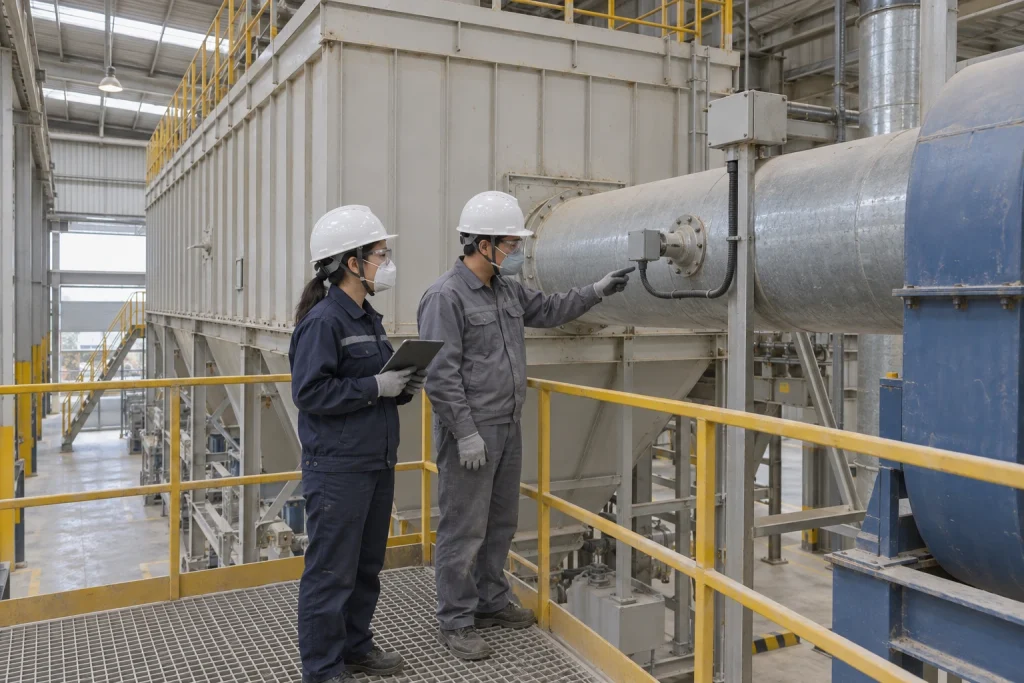
Identify whether the sensor will monitor a room, an extraction duct or the outlet of a dust collector. A device intended for moving particles inside ductwork should not be selected for still-air monitoring without documented suitability. Position also matters: bends, leakage points, obstructions and changing ventilation can affect how representative a reading is.
Record normal and exceptional conditions separately. Include humidity, possible condensation, temperature changes, abrasive particles, sticky deposits and cleaning practices. For outdoor installations, evaluate weather exposure and access. Ask the supplier to explain how these conditions affect the selected sensor and what servicing is required, rather than assuming an enclosure rating resolves every environmental concern.
Access for inspection and cleaning belongs in the initial design. Define how technicians can safely isolate the process, reach the instrument and restore it after maintenance. Where the location has a combustible dust hazard, the equipment suitability review must address that specific environment. Gas-related equipment documentation alone should not be taken as evidence of suitability for a dust installation.
Specify Alarms, Verification and Purchasing Evidence
An alarm needs an agreed response. For a collector outlet, the action might be to investigate possible filter damage. Around powder transfer equipment, it might be to inspect extraction performance and follow the site’s exposure-control procedure. Document who receives the signal, who investigates and which operating conditions require escalation.
Establish normal behavior during commissioning across representative operating states, including startup, shutdown and filter cleaning. This baseline can help distinguish process patterns from abnormal changes, but does not by itself establish a safe concentration. Any alarm delay or averaging period needs review against the monitoring objective so that nuisance reduction does not conceal an important event.
Request documentation covering calibration, functional checks, maintenance and fault indication. Confirm how a sensor fault, loss of power or communication failure becomes visible to operators. A working alarm output demonstrates only part of the system: verification must also consider whether the sensing element and installation provide a meaningful measurement.
Compare quotations against the same written application brief. Require suppliers to distinguish relative trend indication from calibrated concentration measurement and to state limitations. Include consumables, cleaning access and commissioning responsibilities in the comparison. This makes the selection more useful than ranking devices by a headline range or an unexplained sensitivity figure.
Why ASA
ASA’s product lines cover gas detectors, dust alarm detectors and gas alarm controllers, providing a starting point for industrial monitoring discussions. Explore the dust alarm detector category with a clear description of your powder and process. Confirm the sensing principle, installation requirements and available engineering support for the proposed model before making a selection.
For a focused technical review, provide the material details, monitoring objective, location, operating conditions and required alarm actions. Contact ASA to discuss your application and clarify documentation, support arrangements and project timing before procurement.
Disclaimer: Product availability, specifications, measuring ranges, alarm configurations and certification coverage vary by model and region. The information in this article is provided for general reference only and does not constitute a performance guarantee, safety assurance or compliance statement. Always refer to the official product documentation and confirm suitability, certification status and local regulatory requirements with our team before selection, installation or use.