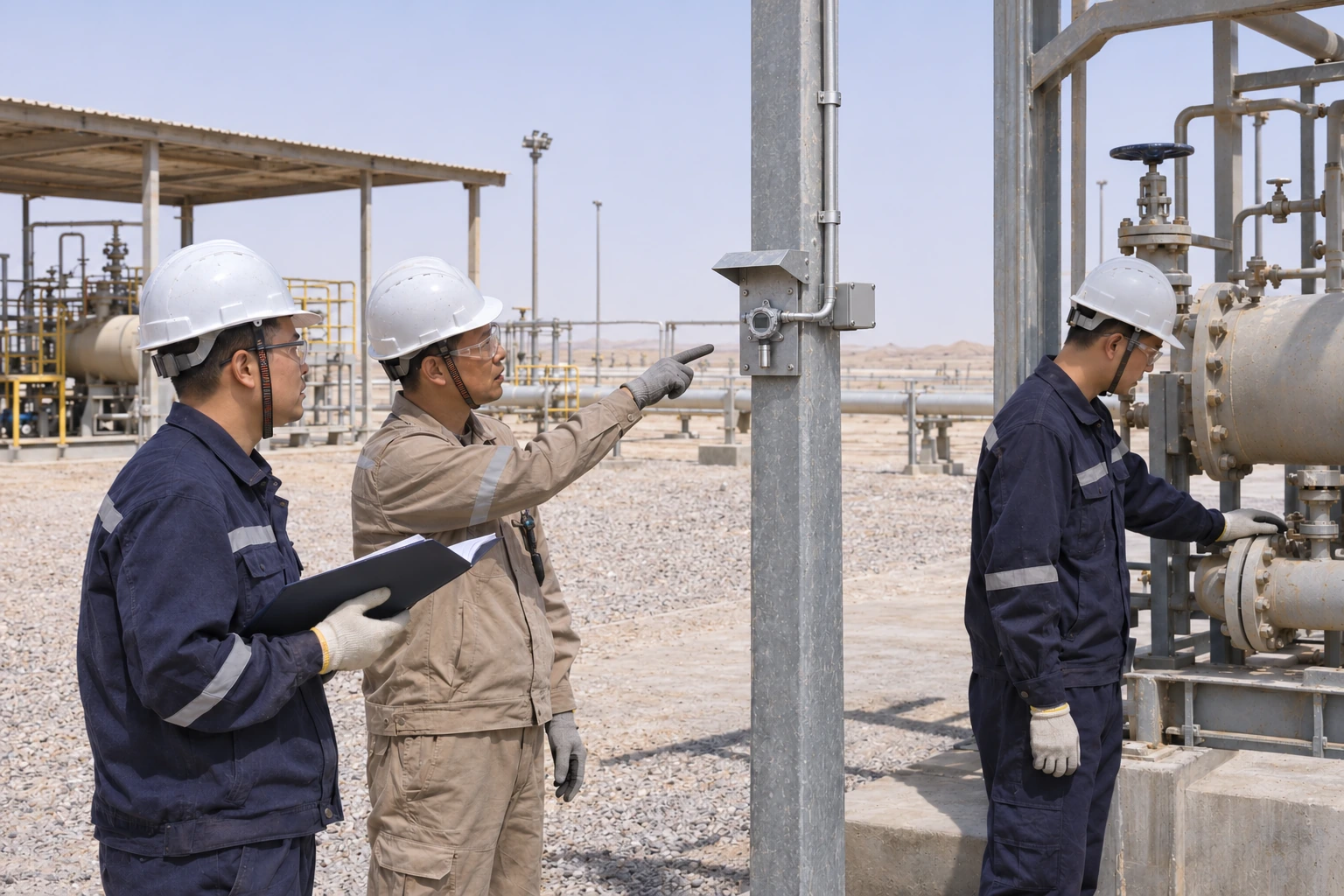
Choosing a tdlas methane detector starts with defining what the instrument must measure and how its signal will be used. Industrial buyers comparing laser TDLAS with non-dispersive infrared, or NDIR, need more than a ranking of sensor technologies. Accuracy, response speed and price depend on the complete detector, its measurement arrangement and the installation. A point detector near a potential leak, an open-path instrument across an area and a process analyzer answer different questions. Comparing them as interchangeable products can lead to an unsuitable specification even when each instrument performs correctly.
Start With the Measurement Task
Both technologies use the absorption of light by gas molecules. TDLAS tunes a narrow-band laser across a selected absorption feature, allowing the instrument to distinguish the target gas through its spectrum. NDIR uses optical filters to select measurement bands without scanning a laser across an individual absorption line. These differences influence selectivity and instrument design, but do not establish a universal performance ranking. For background on laser selectivity, see Yokogawa’s explanation of tunable diode laser spectroscopy.
First decide whether the objective is combustible-gas warning, methane leak investigation or process concentration measurement. Low-concentration leak detection and flammable-atmosphere monitoring may require different ranges, outputs and validation procedures. An instrument intended for process analysis should not automatically be treated as a suitable safety alarm detector.
Also separate sensing technology from measurement geometry. A point instrument measures gas at its sensing location. An open-path instrument measures absorption along a beam and may report a path-integrated value. That reading does not directly identify the peak concentration or the position of gas along the beam. Write the required units and measurement arrangement into the enquiry before comparing quotations.
Compare Accuracy Under Relevant Conditions
Ask suppliers how accuracy is defined: as a proportion of reading, a proportion of full scale, an absolute error or a combination. Two apparently similar percentages can represent very different uncertainties at the intended alarm level. Repeatability, resolution and detection limit describe other aspects of performance and should not be substituted for accuracy.
TDLAS can offer strong methane selectivity through its choice of absorption line. That does not remove the need to evaluate temperature, pressure, background gas composition and optical condition. Request evidence covering the conditions that matter to the installation, including changes between normal operation and a release scenario.
NDIR response to other gases depends on the selected optical bands and the instrument’s design. A methane-calibrated reading should not be assumed to quantify every combustible gas equally. Honeywell’s technical note on sensor cross-sensitivities illustrates why the calibration gas and response to other gases matter. Ask for the specific detector’s interference information rather than transferring figures between models.
For either approach, request calibration requirements, stated operating conditions and information about long-term stability. Establish how the installed instrument will be checked and what evidence will trigger maintenance. Neither an optical measurement principle nor a stable laboratory result justifies assuming that field verification is unnecessary.
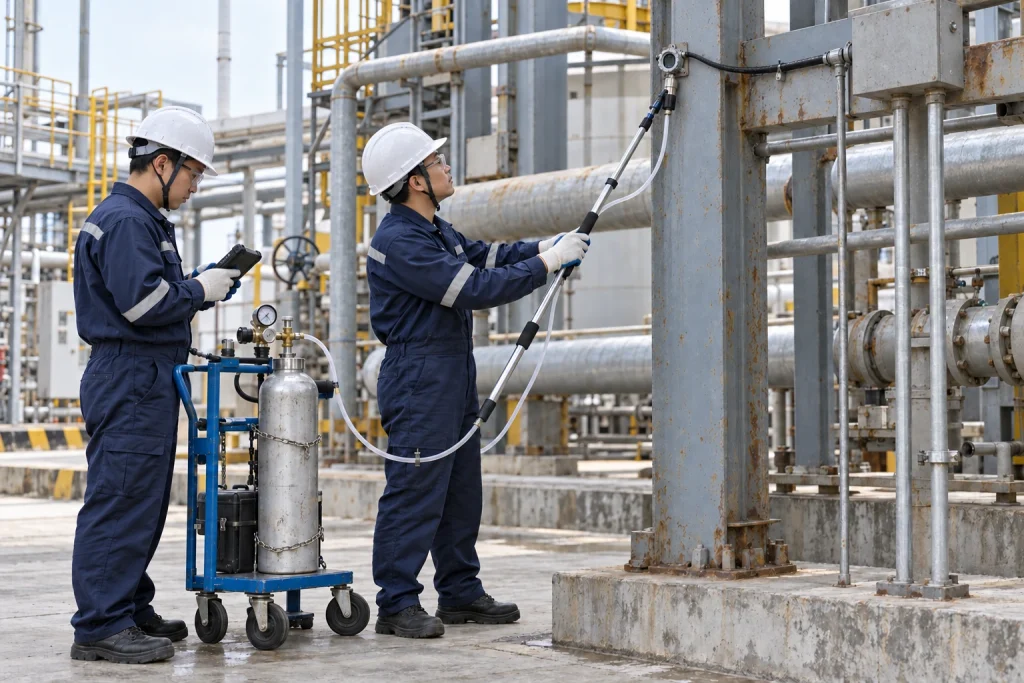
Evaluate Speed Across the Complete Alarm Chain
A fast optical measurement does not necessarily produce an equally fast alarm at the control room. Gas must reach the sensing location or intersect the beam. Enclosures, filters, sample tubing, signal averaging, communication settings and controller logic can all add delay. Compare documented response under the proposed configuration, rather than comparing a laser scan rate with a complete detector response time.
When a supplier quotes T90, confirm the test conditions and what the time interval includes. For an extractive system, consider sample transport and conditioning separately. For a diffusion instrument, check whether the quoted result includes the accessories planned for installation. A headline number without this context is insufficient for an engineering comparison.
Placement also affects when a release becomes detectable. Ventilation, release direction, obstructions and weather can change the route taken by a gas cloud. For outdoor optical paths, evaluate visibility, alignment and obstruction handling. These issues belong in the site assessment regardless of which sensing technology is preferred.
Compare Price on an Equivalent Scope
There is no reliable universal price ratio between TDLAS and NDIR methane detectors. Quotes may cover different measurement tasks, installation hardware and service provisions. Request prices against the same functional requirements and identify items excluded from the initial offer.
A useful comparison includes the following:
- Detector hardware, mounting accessories and any required optical-path components.
- Power, cabling, communications and integration with the alarm system.
- Commissioning, functional checks and the equipment needed for routine verification.
- Cleaning access, spares, replacement procedures and service logistics.
TDLAS may be evaluated where methane selectivity or a particular remote measurement arrangement addresses a defined need. NDIR may be considered for fixed combustible-gas monitoring where the proposed detector meets the application requirements. The procurement decision should follow documented suitability and ownership cost, without assuming that the more expensive technology necessarily improves the site’s outcome.
Send each supplier the same description of expected gases, environmental conditions, measurement objective, output requirements and maintenance access. Ask them to distinguish confirmed capabilities from options requiring further review. This makes price differences easier to interpret and reduces the risk of comparing incomplete scopes.
Why ASA
ASA’s product lines cover gas detectors, dust alarm detectors and gas alarm controllers, providing a starting point for equipment selection discussions. Buyers assessing fixed methane monitoring can review the Methane CH4 Gas Alarm Detector as a candidate for further evaluation. This comparison does not assign either optical technology to that product; confirm its sensing principle and suitability through the current documentation.
Share the project requirements with ASA to discuss product selection and engineering questions before ordering. Include the installation location, intended measurement and maintenance arrangements so the enquiry can be assessed efficiently. For model-specific information, availability and the expected response timeline, contact ASA with your methane detection requirements.
Disclaimer: Product availability, specifications, measuring ranges, alarm configurations and certification coverage vary by model and region. The information in this article is provided for general reference only and does not constitute a performance guarantee, safety assurance or compliance statement. Always refer to the official product documentation and confirm suitability, certification status and local regulatory requirements with our team before selection, installation or use.