
Effective chlorine gas detection in water treatment chlorination rooms starts with understanding the installation, the people who enter it and the actions expected when an alarm occurs. A purchasing specification should connect these elements before equipment is selected. For industrial buyers in Europe and the Middle East, a useful starting point is a room layout and a written description of normal operation, cylinder handling, maintenance and unattended periods. These documents help suppliers assess the application without assuming that a general gas detector is suitable for chlorine service.
Define the Chlorination Room and Its Detection Objective
First establish which treatment process the room actually contains. Chlorine gas feed equipment and liquid hypochlorite dosing equipment involve different arrangements and potential release scenarios. A project description that simply says “chlorination room” leaves important questions unanswered. Record the chemicals present, storage arrangements, connection points and adjacent occupied spaces. Include activities that change the operating conditions, such as deliveries, equipment changeover and maintenance isolation.
State whether the proposed system is intended to monitor a storage room, a dosing equipment enclosure or several separate areas. Identify who receives an alarm during each shift and outside normal working hours. A detector specification is incomplete if the purchasing team cannot identify the person or team responsible for responding. Room monitoring should also be distinguished from process measurement: an instrument used to measure disinfectant in treated water does not establish the condition of the room atmosphere.
The UK Health and Safety Executive’s guidance on handling chlorine from drums and cylinders recommends chlorine detectors and alarms in buildings containing chlorine containers or process plant. It also discusses warnings at staffed locations and links to ventilation and isolation equipment. Use this guidance as a technical reference, with the applicable local requirements reviewed separately for the project.
Select a Detector for the Actual Service Conditions
Specify chlorine explicitly as the target gas and request documentation supporting the proposed sensing method. An oxygen monitor, combustible gas detector or general-purpose instrument should not be treated as a substitute for a chlorine detector. Ask the supplier to explain the intended application, relevant limitations and maintenance requirements for the exact configuration being offered.
Provide the expected ambient conditions, including temperature changes, humidity, washdown practices and any other chemicals used nearby. Ask how these conditions affect the proposed sensor and enclosure. Request information on cross-sensitivity and on conditions that could cause an unreliable reading. Where sampling tubing is proposed, have the supplier assess the complete sampling arrangement rather than evaluating only the sensing element.
Measuring range, resolution and alarm settings should follow the assessed hazard and the site’s response plan. Avoid copying values from an unrelated installation or assuming that a larger range is always preferable. Ask for the basis of the proposed range and the limits of the measurement. Any exposure criteria used in the assessment should be checked against the applicable jurisdiction and their averaging periods.
A practical bid comparison can include the exact sensor identification, environmental limits, calibration method, replacement requirements and documented outputs. Buyers reviewing ASA gas alarm detector options should confirm chlorine-specific availability and suitability directly with the team. A general product category does not establish that a particular model covers this application.
Plan Locations and Alarm Actions Together
Detector placement needs a review of potential release points, air movement and the areas requiring warning. Avoid treating one standard mounting height as a complete design. The HSE chlorine handling guidance discusses locations around pipework ducts, extraction arrangements and storage or use areas. The final layout should be assessed for the actual room, including operating ventilation and possible stagnant areas.
Prepare a drawing that identifies each proposed detector and its monitored area. Add doors, equipment, ventilation openings and access routes. During review, ask whether maintenance staff can reach the sensor safely and whether future equipment changes could obstruct it. Document the reasoning for each location so that later modifications can be evaluated against the original design intent.
Write an alarm action schedule before selecting interfaces. For each signal, identify the indication required, the recipient and any proposed automatic action. Ventilation and isolation responses require engineering review of the complete installation; a generic instruction to start a fan may not suit the site’s containment arrangement. The HSE’s general guidance on leak and gas detection emphasizes appropriate positioning, protective devices, recognizable warnings and procedures for responding to alarms.
Make fault and maintenance indications understandable to operators. Specify how a loss of monitoring is reported and who can authorize a temporary impairment. An alarm response plan should prioritize withdrawal from affected areas and escalation to trained personnel. Staff should not enter a suspected release area merely to inspect the display or identify the leak.
Include Verification and Maintenance in Procurement
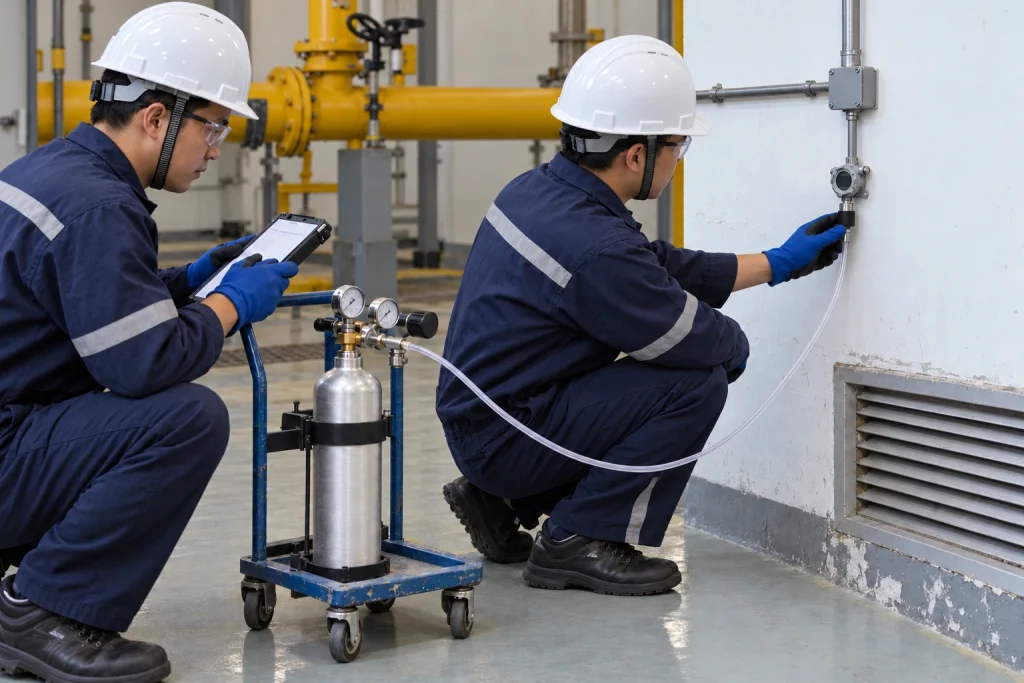
Request a commissioning plan with defined acceptance criteria and responsibilities. It should address the installed measurement equipment, signal paths, alarm indications and any approved interfaces. Distinguish checking an electrical output from checking the sensor’s response using the manufacturer’s specified procedure. Successful communication with a controller alone does not demonstrate that the sensing element is working correctly.
Agree on maintenance instructions, suitable test materials, recordkeeping and access to replacement parts before ordering. Ask who will perform routine work and how monitoring interruptions will be managed. Include training and handover documents in the purchase scope. Keep records of sensor replacement, calibration, faults and configuration changes so that recurring issues can be investigated.
Review the system after changes to room layout, ventilation, chemical storage or operating practices. A detector that remains electrically connected may no longer cover the intended release scenario after such changes. Assign ownership of these reviews rather than leaving them as an informal responsibility shared between departments.
Why ASA
ASA’s product scope includes gas detectors, dust alarms and gas alarm controllers, giving buyers a starting point for discussing industrial monitoring requirements. For a chlorine application, begin with an engineering discussion of the target gas, room arrangement, interfaces and maintenance expectations. Confirm the proposed equipment and support scope in writing before selection. Contact ASA with your chlorination room requirements to discuss availability, documentation and the next steps for evaluating a suitable configuration.
Disclaimer: Product availability, specifications, measuring ranges, alarm configurations and certification coverage vary by model and region. The information in this article is provided for general reference only and does not constitute a performance guarantee, safety assurance or compliance statement. Always refer to the official product documentation and confirm suitability, certification status and local regulatory requirements with our team before selection, installation or use.