
A portable detector daily check gives industrial teams a consistent way to review an instrument before it accompanies a worker into the field. For procurement and maintenance teams across Europe and the Middle East, the routine also creates a practical link between equipment selection, operator training and service planning. A powered display alone does not establish that a detector is ready. Readiness depends on its condition, sensor configuration, functional checks and suitability for the planned task.
1. Confirm the Instrument Matches the Job
Start with the work assignment and the site’s risk assessment. Confirm which atmospheric hazards require monitoring and whether the assigned instrument has the appropriate sensors. A detector measures only what its installed sensing technology is intended to detect. The number of channels on its screen does not establish coverage for every hazard that might be present.
Check the instrument identity against the issue record. Shared fleets benefit from a clear serial number, named user and defined return location. Review any outstanding fault reports or service restrictions before handing over the unit. If its condition or maintenance status is uncertain, refer it to the responsible person and arrange an approved replacement.
Review the intended operating environment against the manufacturer’s documentation. Temperature, moisture, airborne contamination and the sampling method can affect suitability. For sites operating in different jurisdictions, the procedure should identify who confirms applicable requirements. A generic daily checklist cannot make that decision on behalf of the site’s competent personnel.
2. Inspect the Housing, Power and Sampling Path
Look for cracks, loose fittings, damaged clips and contamination around sensor openings. Confirm that the display is readable and that buttons can be operated normally. Check that inlet filters and protective components are present and in acceptable condition under the manufacturer’s instructions. Avoid improvised cleaning methods, solvents or tools that could damage membranes or push contamination into the instrument.
Check the battery indication and planned duty period. Charging arrangements should follow the instrument instructions and site procedure. A low battery at issue time creates an avoidable interruption, especially when workers are remote from the equipment store. Include approved charging accessories and replacement arrangements in the fleet maintenance plan.
Where a pump and sampling line are used, inspect the complete assembly, including tubing, connectors, probe and any specified water trap. Confirm that accessories are compatible with the intended measurement. Carry out the manufacturer’s pump and flow checks. A leak or obstruction in the sampling path can undermine the sample reaching the sensors.
Allow for the specified sample transport and instrument response time when following the sampling procedure. Do not assume that a reading immediately after moving a probe represents the new location. The relevant delay depends on the actual equipment and sampling arrangement; it should come from approved instructions rather than a generic checklist.
3. Verify Sensor Response and Alarm Operation
Follow the startup sequence and review all displayed warnings. Complete any required warmup before checks or measurements. Zeroing must follow the manufacturer’s instructions in a suitable clean atmosphere or with the specified zero gas. An apparently normal display is not independent evidence that the surrounding air is suitable for zeroing.
A bump test exposes sensors to appropriate test gas to check response and alarm operation. It does not establish measurement accuracy. A calibration check compares readings with a known gas concentration, while calibration adjusts the instrument. These activities serve different purposes and should be identified separately in the daily procedure.
OSHA guidance on portable gas monitor testing cites the ISEA recommendation for a bump test or calibration check before each day’s use, following manufacturer instructions. It also advises using traceable test gas within its expiry date. Treat this as technical guidance and confirm the procedure required for the instrument and site.
Use the specified gas mixture, regulator, adapter and test sequence. Verify the required audible, visual and vibration indications where fitted. Apply the manufacturer’s acceptance criteria. If the instrument fails, remove it from use until the prescribed corrective action and successful verification are complete. Do not silence a fault and issue the detector anyway.
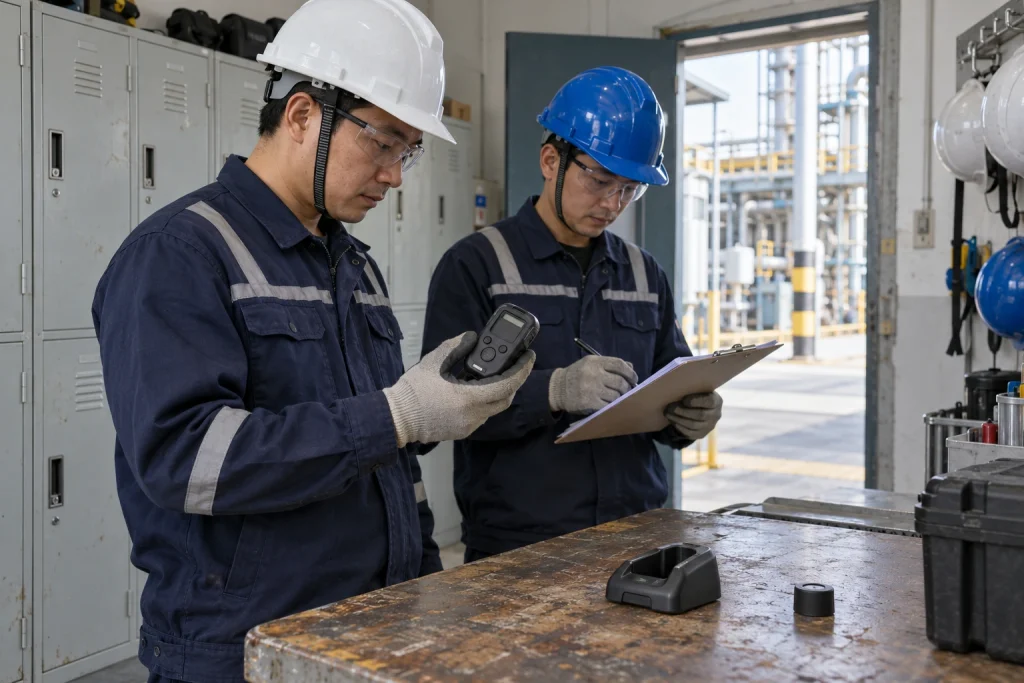
4. Record the Result and Control the Handover
Make the record simple enough to complete consistently. Useful entries include the date, instrument identity, operator, inspection result, functional test result and any corrective action. Keep calibration and service records accessible to the person authorizing issue. A tick beside “checked” provides little help when the team later needs to understand which checks were performed.
Define a clear route for failed instruments. Label them, separate them from available stock and assign responsibility for assessment. Stores personnel should know how to obtain a replacement without returning a questionable unit to circulation. Procurement teams can support this process by planning for service downtime and the consumables required by the selected equipment.
At handover, confirm that the worker understands how to wear or carry the detector, recognize alarms and follow the site’s response procedure. Passing a pre-use check does not establish that an area is safe to enter. Confined-space work, in particular, requires its own authorized assessment, entry arrangements and emergency planning.
Review reported damage, unexpected readings and faults after use. These observations help the maintenance team decide whether further checks are needed before reissue. A daily routine works best when operators can report concerns promptly and receive a clear response.
Why ASA
ASA’s product range includes gas detectors, dust alarms and gas alarm controllers. For projects that also require permanent monitoring, explore the gas detector range as a starting point for a separate equipment review. Fixed monitoring and personal monitoring serve different operational purposes, and each needs a suitable selection and maintenance process.
Bring the application, target hazards, installation conditions and maintenance expectations to the engineering discussion. Contact ASA to discuss your monitoring requirements, request relevant product documentation and clarify available support before preparing a purchase specification.
Disclaimer: Product availability, specifications, measuring ranges, alarm configurations and certification coverage vary by model and region. The information in this article is provided for general reference only and does not constitute a performance guarantee, safety assurance or compliance statement. Always refer to the official product documentation and confirm suitability, certification status and local regulatory requirements with our team before selection, installation or use.