For buyers specifying equipment for hazardous areas, an ATEX gas detector marking is far more than a regulatory formality: it is a compressed technical statement about where a device may be installed, which gas atmospheres it is designed for, and how hot its surfaces are allowed to become. Procurement teams in Europe and the Middle East regularly compare fixed gas detectors from different suppliers, and the Ex marking string printed on the nameplate is often the fastest way to check whether a candidate product matches the classified zones on site. This guide explains, element by element, how ATEX and IECEx markings on gas detection equipment are structured and how to read them with confidence.
ATEX and IECEx: Two Frameworks, One Technical Language
ATEX refers to the European Union framework for equipment intended for use in potentially explosive atmospheres, based on Directive 2014/34/EU. Products placed on the EU market for hazardous areas carry the CE mark together with the distinctive Ex hexagon symbol and an equipment group and category code. IECEx, by contrast, is an international certification scheme operated under the IEC, built on the IEC 60079 series of standards. It is widely referenced in the Middle East, Asia and other regions outside the EU.
The good news for specifiers is that both systems rely on essentially the same technical vocabulary. The protection concept codes, gas groups, temperature classes and equipment protection levels described below appear in both ATEX and IECEx markings, because the underlying IEC 60079 and EN 60079 standards are closely harmonized. A detector sold internationally may carry both markings side by side on the same label.
Reading the ATEX Group and Category Code
A typical ATEX-specific portion of a marking looks like this: II 2G. Each element has a defined meaning:
- Equipment group: Group I covers equipment for mines susceptible to firedamp; Group II covers surface industries such as chemical plants, refineries, painting lines and wastewater facilities. Most industrial gas detectors belong to Group II.
- Category: Category 1 equipment is designed for areas where an explosive atmosphere is present continuously or for long periods; Category 2 for areas where it is likely to occur in normal operation; Category 3 for areas where it is unlikely and short-lived.
- Atmosphere letter: G indicates gas, vapor and mist atmospheres; D indicates combustible dust atmospheres. A marking such as 2GD signals suitability for both types, subject to the rest of the marking string.
The category maps to the zone model used in area classification. In broad terms, Category 1G equipment may be evaluated for Zone 0, Category 2G for Zone 1, and Category 3G for Zone 2, with the dust equivalents applying to Zones 20, 21 and 22. The final decision always rests with the plant’s own hazardous area classification and the responsible engineer.
Decoding the Ex String: Protection Concept, Gas Group, Temperature Class
After the ATEX group and category, the marking continues with a string such as Ex db IIC T4 Gb. This is the part shared with IECEx, and it carries most of the engineering detail.
Protection concept. The lowercase letters after Ex describe how ignition is prevented. Common concepts on gas detection equipment include: d or db (flameproof enclosure, which contains an internal explosion and prevents it from igniting the surrounding atmosphere), e or eb (increased safety, applied to terminals and connection compartments), i with the variants ia, ib and ic (intrinsic safety, which limits electrical energy so that sparks and thermal effects cannot ignite the atmosphere), m (encapsulation) and p (pressurized enclosure). Fixed point detectors are commonly built with flameproof enclosures, sometimes combined with increased safety terminal compartments, while portable instruments and some sensor circuits often rely on intrinsic safety.
Gas group. IIA, IIB and IIC rank gases by how easily they ignite and how severe their explosion behavior is. IIA is typified by propane, IIB by ethylene, and IIC by hydrogen and acetylene, the most demanding group. Equipment certified for IIC also covers IIA and IIB atmospheres, so a IIC marking offers the widest applicability for gas atmospheres.
Temperature class. T1 through T6 state the maximum surface temperature the equipment can reach: T1 corresponds to 450 C, T2 to 300 C, T3 to 200 C, T4 to 135 C, T5 to 100 C and T6 to 85 C. The class must be compared against the auto-ignition temperature of the gases present on site; the equipment’s maximum surface temperature must stay safely below that value. T4 is a common class for gas detectors and covers many industrial solvents and fuel gases, but the comparison should always be made gas by gas.
Equipment protection level (EPL). Modern markings end with Ga, Gb or Gc for gas atmospheres (Da, Db, Dc for dust). These express the level of protection directly: Ga for a very high level suitable for Zone 0, Gb for Zone 1, and Gc for Zone 2. The EPL and the ATEX category should tell a consistent story on a correctly marked label.
A Worked Example and Practical Checks for Buyers
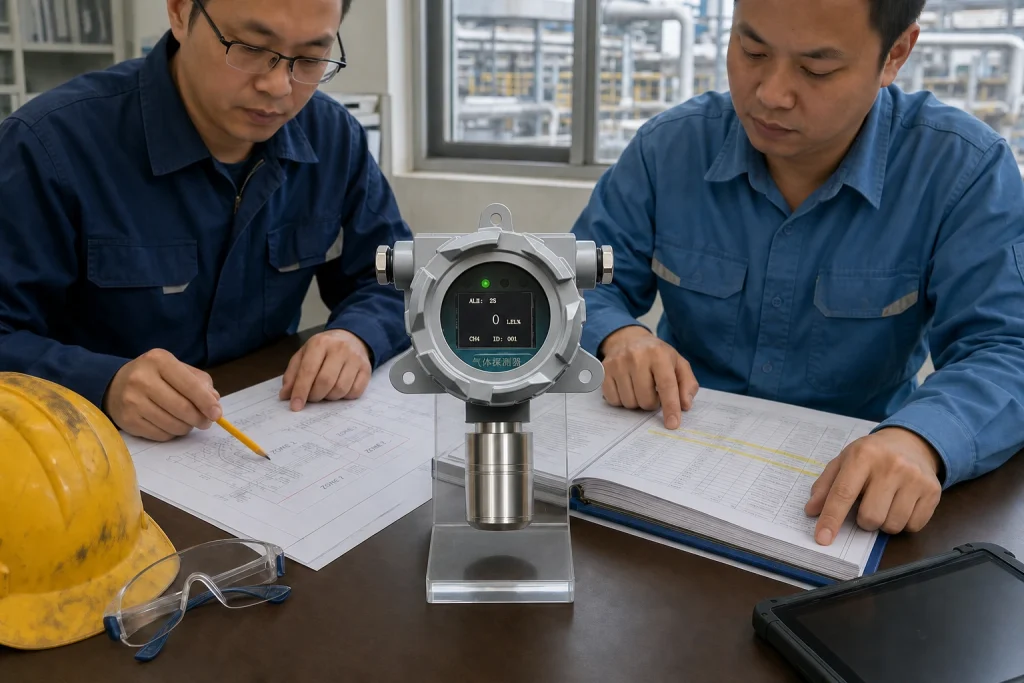
Consider a nameplate reading: CE, Ex hexagon, II 2G Ex db eb IIC T4 Gb. Read left to right, this describes surface industry equipment (II), Category 2 for gas atmospheres (2G), protected by a flameproof enclosure with an increased safety connection compartment (db eb), certified for the most demanding gas group (IIC), limited to a 135 C maximum surface temperature (T4), at a protection level appropriate for Zone 1 (Gb).
When evaluating quotations, a few practical checks help avoid costly mismatches:
- Match the category and EPL to the actual zone classification of each measurement point, not to the plant as a whole. Different locations on one site can carry different zone ratings.
- Check the gas group against the specific gases handled. Hydrogen service, for example, calls for IIC-rated equipment.
- Compare the temperature class with the auto-ignition temperatures of all substances present, not only the target gas.
- Ask for the certificate itself, not just the marking. Certificates state conditions of use, ambient temperature ranges and any X suffix denoting special installation conditions.
- Remember that gas alarm controllers and other equipment installed in the safe area are typically outside the hazardous zone; the field devices connected to them are where Ex markings matter most. Suitable fixed detectors can be reviewed in our gas alarm detector product center, and matching control units in the gas alarm controller range.
Why ASA
ASA supplies a broad portfolio of fixed gas detectors, dust monitoring devices and alarm controllers for industrial safety applications across Europe and the Middle East. Our engineering team can help you translate a hazardous area drawing into a concrete equipment list, review zone classifications and gas groups point by point, and propose configurations that fit both the application and the budget. With responsive pre-sales support and project-oriented documentation, ASA aims to make hazardous area procurement straightforward rather than stressful. To discuss your gas detection requirements or request a specification review, contact our team today.
Disclaimer: Product availability, specifications, measuring ranges, alarm configurations and certification coverage vary by model and region. The information in this article is provided for general reference only and does not constitute a performance guarantee, safety assurance or compliance statement. Always refer to the official product documentation and confirm suitability, certification status and local regulatory requirements with our team before selection, installation or use.