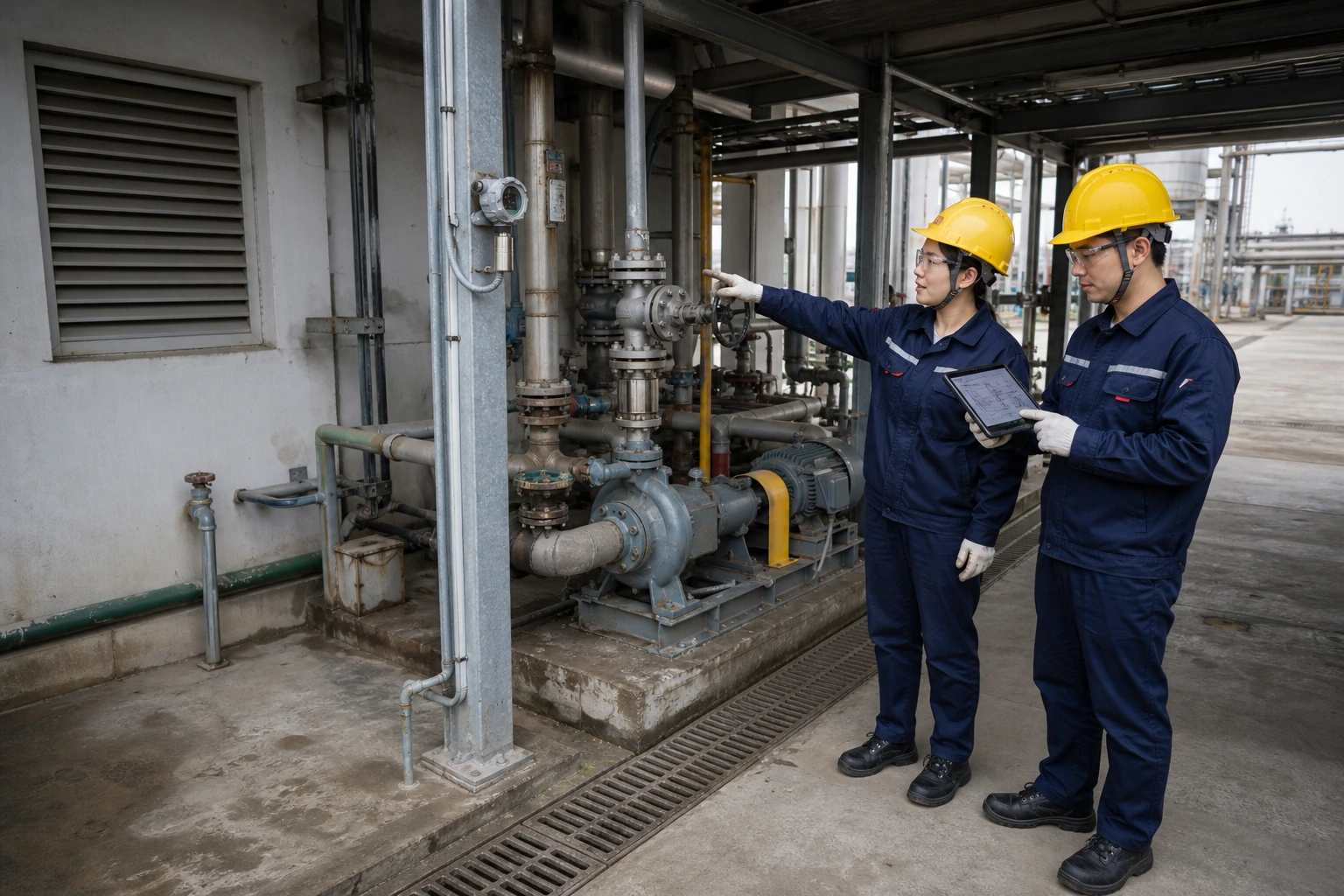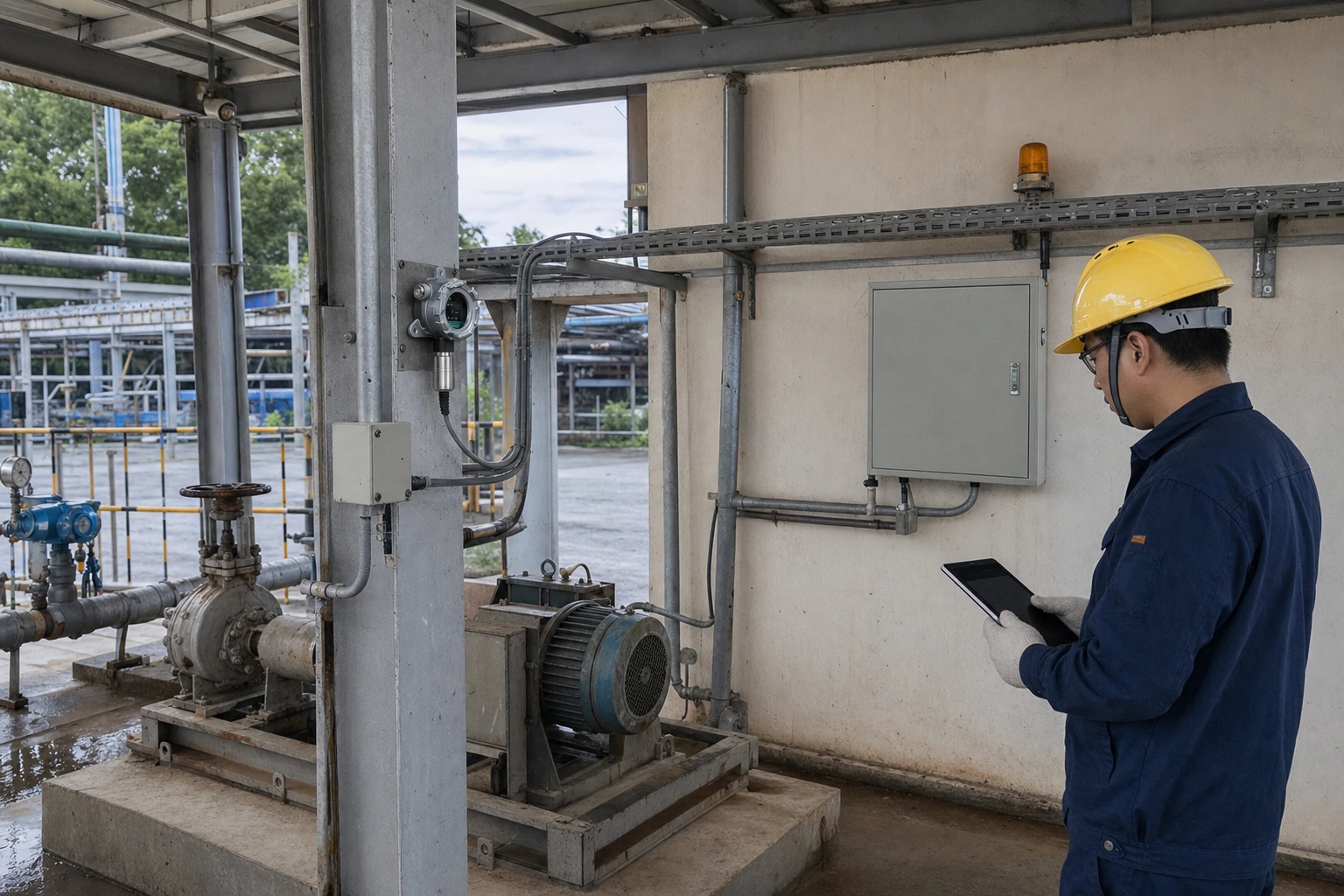
Choosing the correct gas detector installation height is one of the most important decisions in any fixed gas detection project. A sensor with excellent accuracy and a fast response time will still miss a leak if it is mounted where the target gas never accumulates. The single most useful rule of thumb is to start from the density of the gas relative to air: lighter-than-air gases rise toward the ceiling, heavier-than-air gases pool near the floor, and gases with a density close to air disperse more evenly throughout the room. This guide explains how relative gas density translates into practical mounting positions, and which additional site factors should be reviewed before final placement is confirmed.
Why Gas Density Drives Detector Placement
Every gas has a vapor density that can be compared with air, which is assigned a reference value of 1.0. Methane (CH4), with a relative density of roughly 0.55, and hydrogen (H2), at roughly 0.07, are much lighter than air and tend to rise and collect under roofs, canopies and ceiling voids. Propane (C3H8), at roughly 1.5, and butane at roughly 2.0, are heavier than air and tend to sink, spreading along floors, trenches and pits. Carbon monoxide (CO), with a relative density of about 0.97, is so close to air that it mixes readily and does not show a strong tendency to stratify.
Because a fixed detector is a point measurement device, it only responds to gas that physically reaches the sensing element. Placement strategy therefore starts with a simple question: where is the released gas most likely to travel and accumulate? Density gives the first answer, and site-specific airflow refines it.
Lighter-Than-Air Gases: Mount High
For gases such as methane, hydrogen and ammonia (NH3, relative density roughly 0.6), detectors are commonly installed above the potential leak source and near the highest point where gas can collect. A frequently used industry guideline is to position the sensor within approximately 0.3 to 0.6 meters (1 to 2 feet) of the ceiling or roof apex, while keeping it clear of dead air pockets.
Points worth checking during design include:
- Roof geometry. Pitched roofs, beams and ceiling voids can trap rising gas in specific pockets; the detector should be located where the gas is expected to accumulate, not simply at any high point.
- Ventilation openings. Rising gas may follow air currents toward extraction fans or vents, and a detector placed on that path can respond earlier.
- Hydrogen behavior. Because hydrogen is extremely light and buoyant, it disperses upward very quickly, so coverage directly above battery rooms, electrolyzers or compressor sets can be considered.
For flammable gases, fixed detectors in these positions are typically configured to alarm at a fraction of the lower explosive limit (LEL). As reference values, the LEL of methane is widely published as approximately 5 percent by volume in air, and that of hydrogen as approximately 4 percent by volume.
Heavier-Than-Air Gases: Mount Low
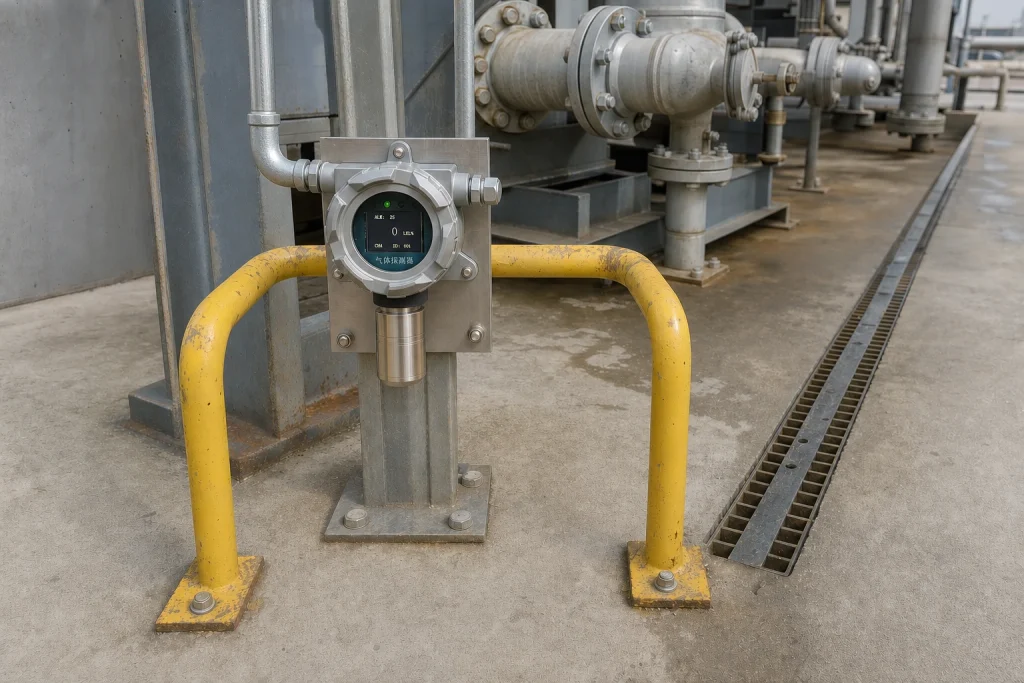
Gases and vapors heavier than air, such as propane, butane, and many solvent vapors, call for the opposite approach. A common guideline is to mount the detector approximately 0.3 to 0.6 meters (1 to 2 feet) above floor level, close to the likely release point. Hydrogen sulfide (H2S), with a relative density of about 1.19, is also somewhat heavier than air and is often monitored at low level in still-air conditions.
Low-level installation brings practical considerations of its own:
- Pits, trenches and sumps. Heavy gases flow like a liquid toward the lowest available space, so cable trenches, drainage channels and below-grade rooms may be evaluated as accumulation points.
- Mechanical protection. Detectors mounted near the floor are exposed to impact from vehicles, pallets and cleaning equipment, so guards or protected mounting positions can be considered.
- Water and dust ingress. Low positions see more splash, wash-down water and settled dust, which makes sensor housing protection and a regular inspection routine more important.
Gases Close to Air Density and Breathing-Zone Monitoring
Carbon monoxide and some other gases with a relative density near 1.0 do not stratify strongly, so placement is usually driven by where people work rather than by ceiling or floor level. A common practice for toxic gas monitoring is to install the detector in the breathing zone, typically around 1.2 to 1.8 meters (4 to 6 feet) above the floor, in areas where personnel are regularly present.
Where a gas is both toxic and flammable, or where a site handles several gases with different densities, a combination of high-level, low-level and breathing-zone detectors may be evaluated, with each point feeding back to a common controller. Multi-channel gas alarm controllers are commonly used to gather signals from detectors mounted at different heights and to drive shared alarms, relays and ventilation interlocks.
Other Placement Factors Beyond Density
Relative density is the starting point, not the whole answer. Before fixing final positions, the following factors are commonly reviewed:
- Airflow and ventilation. Strong mechanical ventilation, open doors and thermal currents can carry gas away from its natural rise or fall path. A smoke tube or tracer test during commissioning can help confirm real airflow patterns.
- Distance from the source. Detectors placed closer to credible leak points, such as valve stations, flanges, compressors and filling positions, generally respond earlier than detectors that rely on room-wide dispersion.
- Temperature and environment. Sensor locations should respect the operating temperature range of the instrument and avoid direct steam, wash-down jets and strong vibration where practical.
- Access for maintenance. Every fixed detector needs periodic bump testing and calibration, so mounting positions should remain reachable with reasonable effort, or remote calibration arrangements should be planned.
- Coverage spacing. A point detector protects a limited area, so larger halls are usually covered with several detectors laid out on a grid that reflects both the geometry and the risk assessment for the site.
Placement decisions are normally documented in the project risk assessment, and guidance from local codes and recognized standards for the selection and installation of gas detection equipment should always take precedence over generic rules of thumb. Typical installation scenarios across process plants, boiler rooms, warehouses and utility spaces are illustrated on our applications page.
Why ASA
ASA supplies fixed gas detection equipment for industrial buyers across Europe and the Middle East, with a product line that covers point gas alarm detectors for combustible and toxic gases, dust concentration monitors and multi-channel alarm controllers. Our engineering team can review your site layout and gas list, suggest mounting heights and detector counts based on the principles described above, and support you from specification through commissioning. With responsive pre-sales and after-sales communication, ASA aims to make detector selection and placement planning straightforward for OEMs, integrators and end users alike. To discuss a placement plan for your facility, contact our team for a consultation.
Disclaimer: Product availability, specifications, measuring ranges, alarm configurations and certification coverage vary by model and region. The information in this article is provided for general reference only and does not constitute a performance guarantee, safety assurance or compliance statement. Always refer to the official product documentation and confirm suitability, certification status and local regulatory requirements with our team before selection, installation or use.