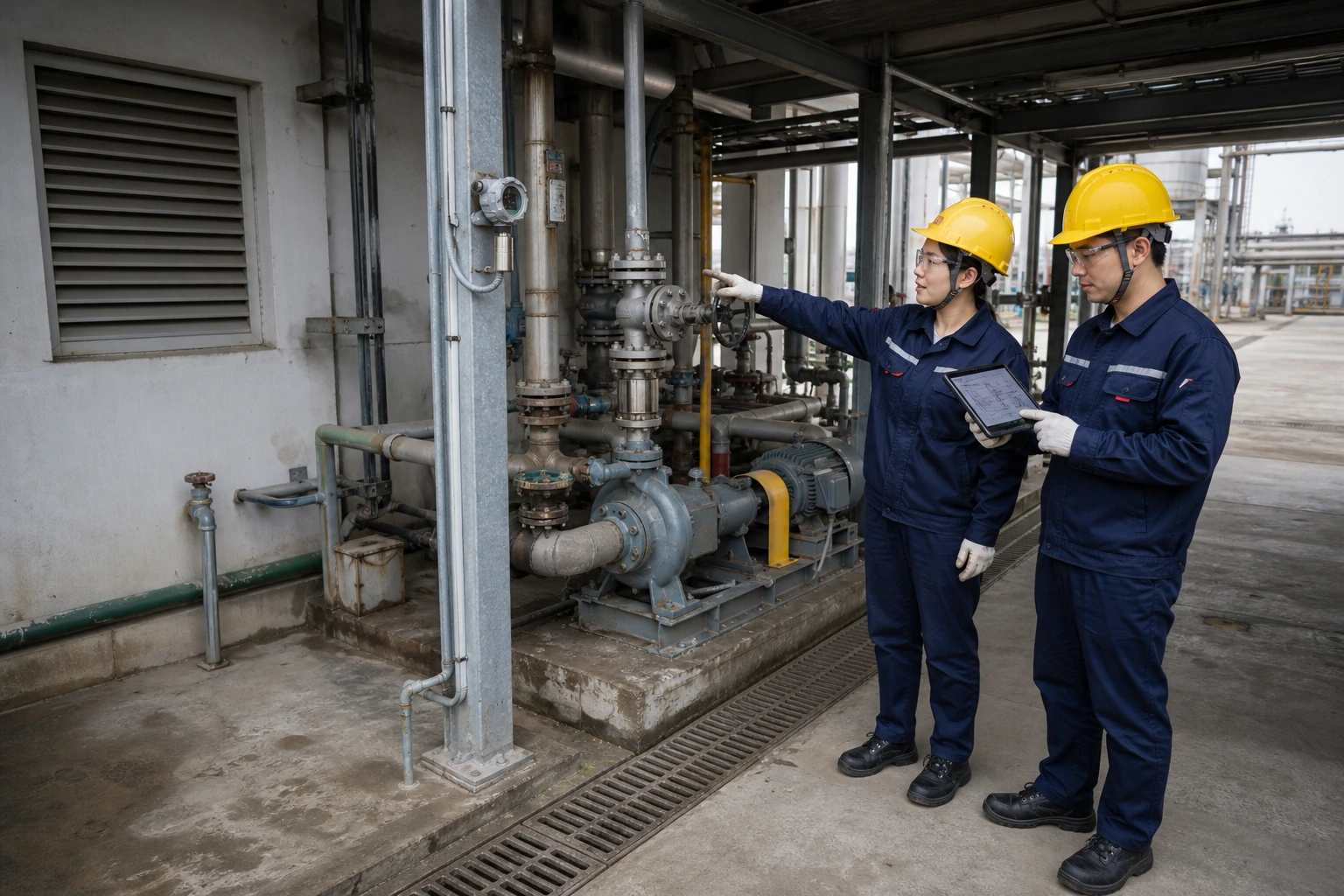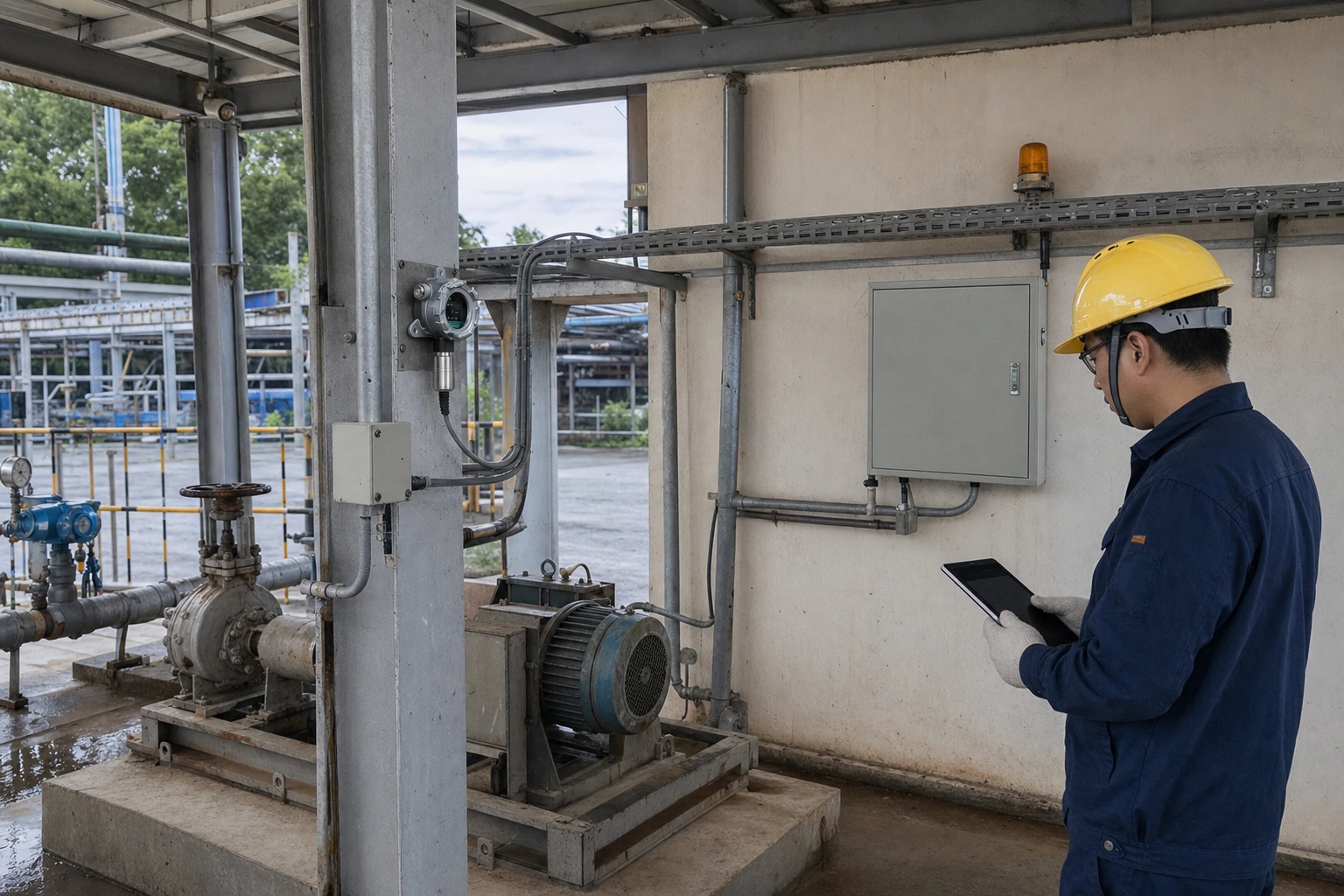
Planning gas detection chemical plant coverage is one of the more demanding tasks in industrial safety engineering, because a single site can combine flammable vapors, toxic process gases and oxygen-deficiency risks within a few hundred meters. Unlike a boiler room or a paint shop, where the hazard list is short and well defined, a chemical plant handles feedstocks, intermediates and finished products that each bring their own detection requirements. This article outlines the typical gas hazards found in chemical processing facilities, how they translate into sensor selection, and the general principles that guide fixed detector layout across process units, storage areas and utility zones.
Typical Gas Hazards in Chemical Processing Facilities
Most chemical plants face three broad hazard families, and many areas contain more than one at the same time.
Flammable gases and vapors are the most widespread concern. Hydrogen (H2) is common in hydrogenation, reforming and electrolysis units and has an exceptionally wide flammable range of roughly 4 to 75 percent by volume in air. Methane (CH4), with a lower explosive limit around 5 percent by volume, appears wherever natural gas is used as feedstock or fuel. Solvent vapors such as toluene, methanol and acetone accumulate around reactors, mixing vessels and tank farms, and heavier-than-air vapors tend to pool in low points such as pits, trenches and drain systems.
Toxic gases form the second family. Hydrogen sulfide (H2S) is encountered in sulfur recovery, wastewater treatment and some petrochemical streams; occupational exposure guidance in many jurisdictions sits in the low single-digit ppm range, far below the level a person can reliably smell over time. Carbon monoxide (CO) arises from incomplete combustion and certain synthesis processes. Ammonia (NH3) and chlorine (Cl2) are staples of fertilizer, refrigeration and water treatment operations, and both can cause serious harm at concentrations well below any flammability concern.
The third family is oxygen deficiency. Nitrogen blanketing, purging and inerting are routine in chemical operations, and a leaking nitrogen line inside a confined or poorly ventilated space can displace breathable air without any warning odor. Areas around inerted vessels, cryogenic storage and analyzer shelters are commonly evaluated for oxygen monitoring for this reason.
Matching Sensor Technology to the Hazard
Once the hazard inventory is complete, each target gas needs an appropriate sensing technology. Catalytic bead sensors are widely used for flammable gases measured in percent LEL, while infrared (NDIR) sensors can be considered where background gases might poison catalytic elements or where oxygen levels may be too low for catalytic operation. Electrochemical cells remain the standard choice for toxic gases such as H2S, CO, NH3 and Cl2 at ppm levels, and photoionization detectors (PID) may be evaluated where low-level VOC monitoring is required around solvent handling areas.
Because chemical plants often need many measurement points feeding a central location, fixed transmitters are typically wired back to gas alarm controllers using 4-20mA or RS485 signals. Multi-channel controllers allow one panel to supervise detectors across several process units, drive local sounders and beacons, and pass alarm states to the plant control system. An overview of suitable panel options is available in our gas alarm controller product center.
Detector Layout: General Placement Principles
Detector placement in a chemical plant follows a small set of physical principles, applied area by area rather than plant-wide.
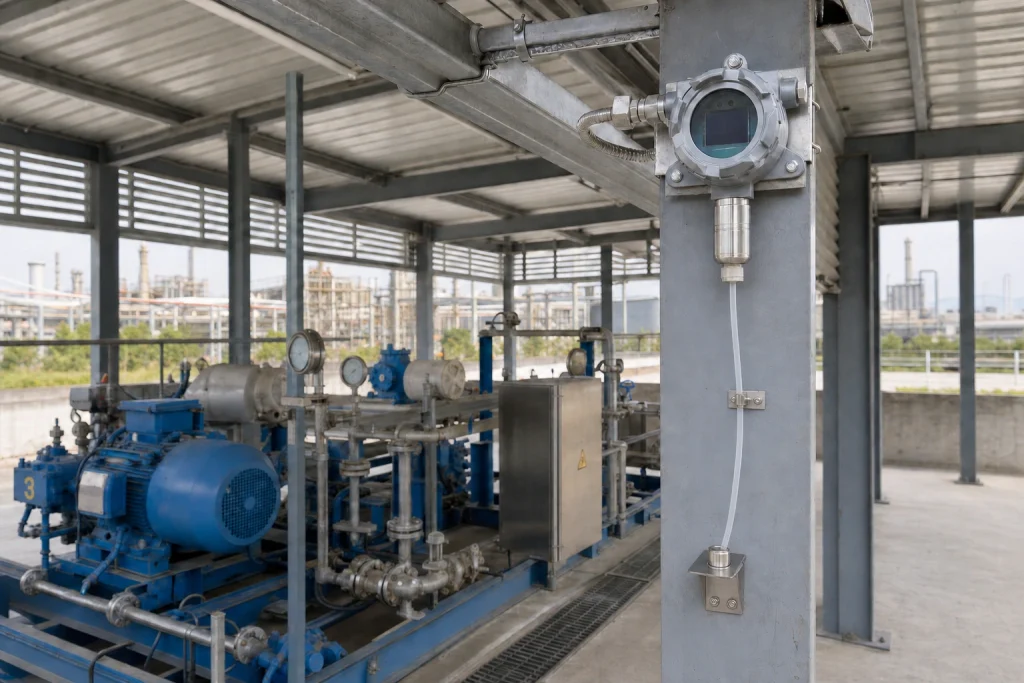
Gas density comes first. Lighter-than-air gases such as hydrogen and methane rise, so detectors for these gases are generally mounted high, near ceilings, roof peaks or above potential leak sources. Heavier-than-air vapors, including most solvent vapors, LPG and chlorine, sink toward the floor, so sensing points are commonly placed 30 to 60 centimeters above grade and near low points where vapor can collect. Gases with density close to air, such as CO, are often monitored at breathing-zone height, roughly 1.2 to 1.8 meters.
Leak sources come second. Detectors are normally positioned close to the equipment most likely to release gas: pump seals, compressor glands, flanges, valve stems, sampling points and loading arms. A detector several meters downwind of a likely leak point will respond far faster than one placed for convenience near a walkway.
Airflow comes third. Ventilation patterns, prevailing wind in open structures and the location of air intakes all influence where a gas cloud will actually travel. HVAC intakes serving control rooms and occupied buildings are frequently monitored so that contaminated air can trigger damper closure before it reaches personnel.
Zoning a Chemical Plant for Detection Coverage
In practice, layout work proceeds by dividing the site into zones with distinct hazard profiles. Process units are assessed around reactors, columns and heat exchangers, with attention to both flammable and toxic streams present in that unit. Tank farms and drum storage areas are commonly covered by low-mounted detectors around bunds and transfer pumps. Loading and unloading bays, where hoses and couplings are repeatedly connected, are frequent alarm locations and benefit from detection near the transfer point. Utility areas, including boiler houses, hydrogen generation and nitrogen systems, carry their own specific risks, and enclosed rooms such as analyzer houses and battery rooms are usually treated as separate detection zones. Typical zone-by-zone examples across industries are described on our applications page.
Alarm philosophy is defined alongside the layout. A common approach uses a low-level warning alarm to prompt investigation and a high-level alarm to initiate executive actions such as shutdown, valve isolation or ventilation changes. Exact setpoints are established by the site’s own risk assessment and applicable local regulations, and detector counts per zone are determined by the geometry of the area rather than by a fixed rule of thumb.
Maintenance Considerations That Affect Layout
A detector that cannot be reached will eventually become a detector that is not maintained. Layout planning therefore accounts for calibration access from the start: sensing points should be reachable for bump testing and span calibration without scaffolding wherever possible, or fitted with remote calibration arrangements where high mounting is unavoidable. Harsh conditions common in chemical plants, such as corrosive atmospheres, washdown areas and heavy dust, also influence enclosure choice and the use of accessories like splash guards and dust filters. Sensor technologies age differently, so the layout documentation should record the technology at each point to support realistic replacement planning.
Why ASA
ASA supplies fixed gas detectors, dust monitors and multi-channel alarm controllers covering flammable, toxic and oxygen measurement across a broad range of target gases, giving chemical plants a single source for multi-hazard detection projects. Our engineering team supports customers through hazard review, point selection and signal integration planning, and our sales engineers respond quickly to specification requests from projects in Europe and the Middle East. To discuss a detection layout for your chemical processing site, contact our team for a consultation.
Disclaimer: Product availability, specifications, measuring ranges, alarm configurations and certification coverage vary by model and region. The information in this article is provided for general reference only and does not constitute a performance guarantee, safety assurance or compliance statement. Always refer to the official product documentation and confirm suitability, certification status and local regulatory requirements with our team before selection, installation or use.