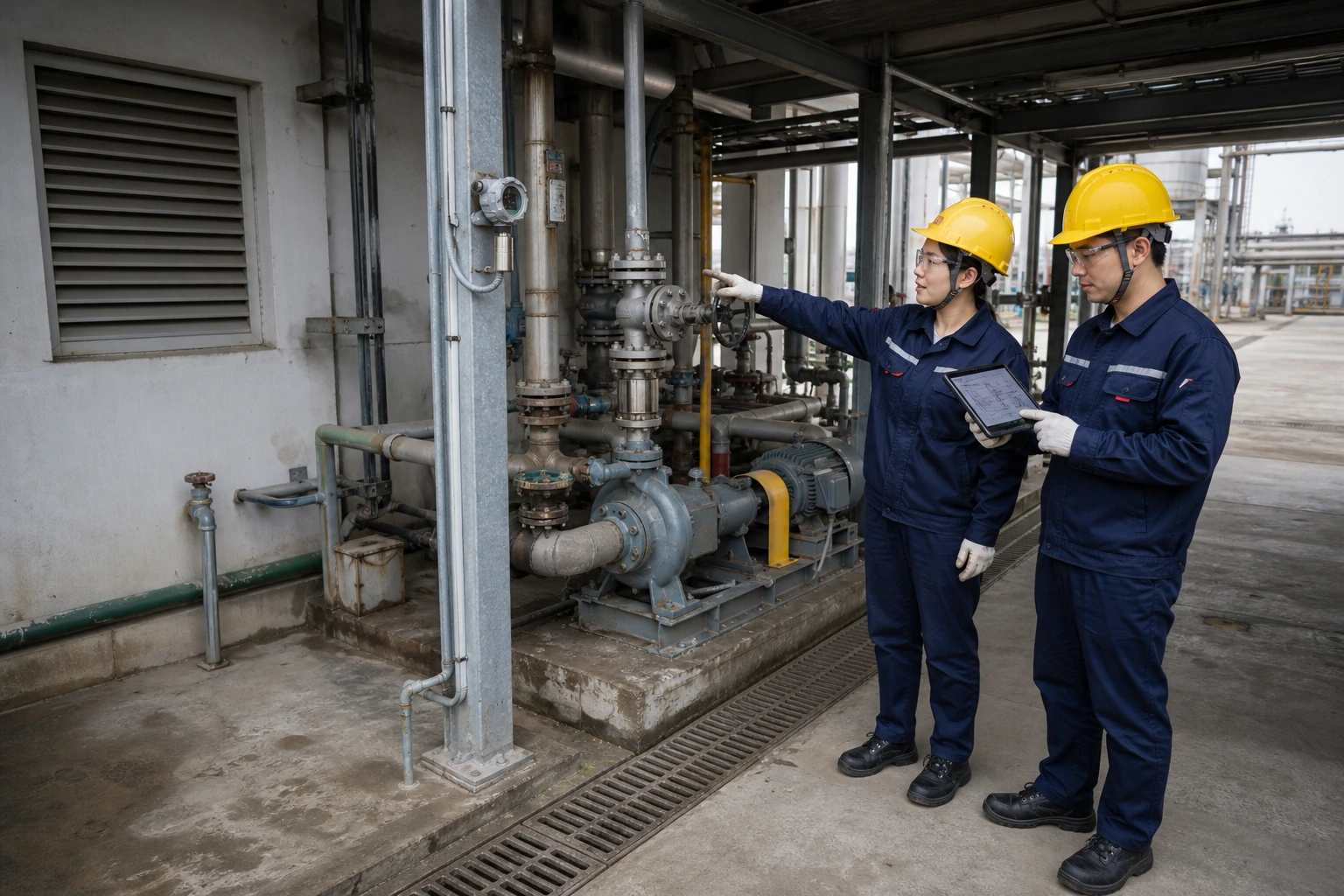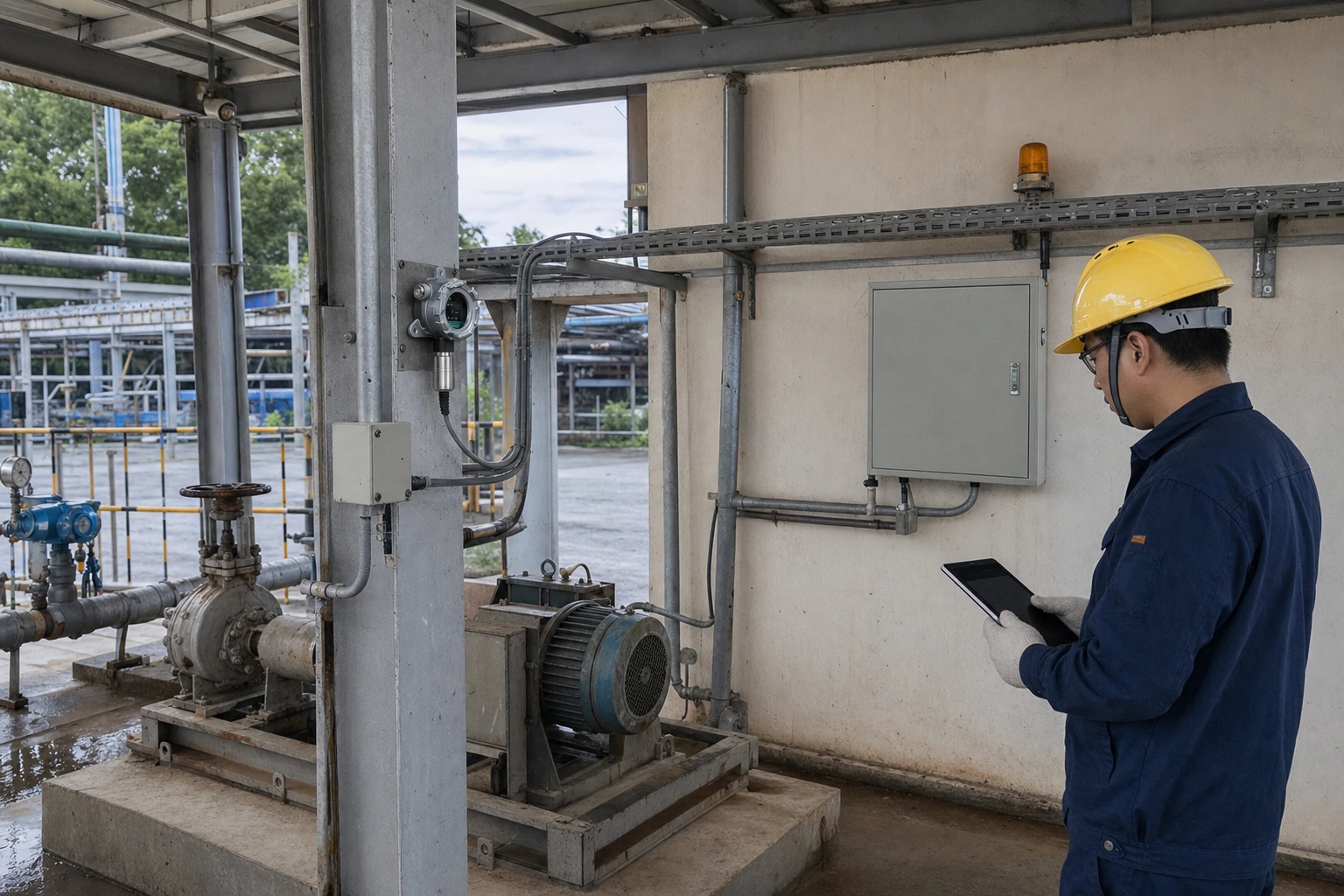
Refineries concentrate almost every gas hazard found in heavy industry within a single fence line, which is why refinery gas detection is treated as core safety infrastructure rather than an optional add-on. Crude oil and its intermediate streams release flammable hydrocarbon vapors, toxic components such as hydrogen sulfide (H2S), and oxygen-displacing gases at many points between the tank farm and the loading bay. A well-planned fixed detection network gives operators early warning of leaks, supports emergency shutdown logic and helps demonstrate duty-of-care to insurers and regulators. This article walks through the main refinery zones, the gases typically monitored in each, and the practical questions procurement and HSE teams should ask when specifying a system.
Why Refineries Need Layered Gas Monitoring
A refinery is not a single hazard environment but a chain of very different ones. Storage areas hold large inventories of flammable liquids at near-ambient conditions, process units run at elevated temperature and pressure, and loading areas bring rotating equipment, hoses and human activity together in one place. A leak that would be a minor event in one zone can be serious in another, so detector type, placement and alarm strategy have to follow the local risk picture.
Three gas families dominate refinery monitoring programs:
- Combustible hydrocarbons – methane, propane, butane, gasoline and naphtha vapors. These are monitored against the lower explosive limit (LEL); as reference points, methane has an LEL of about 5% by volume and propane about 2.1% by volume.
- Toxic gases – above all hydrogen sulfide, which is both highly toxic at low ppm concentrations and flammable at higher ones (LEL around 4% by volume). Carbon monoxide and sulfur dioxide may also be relevant near heaters and sulfur recovery units.
- Oxygen deficiency – a concern in analyzer shelters, pits and other confined or poorly ventilated spaces where inert gases or heavy vapors can accumulate.
Because these risks overlap, most refineries deploy a layered network: catalytic bead or infrared point detectors for combustibles, electrochemical detectors for H2S and other toxics, and dedicated oxygen monitoring in enclosed spaces, all reporting back to central alarm controllers.
Tank Farms: Large Inventories, Slow Leaks
Tank farms store the largest volumes of flammable material on site, but leaks here tend to develop slowly – a passing seal on a floating roof, a weeping valve on a transfer line, vapor escaping during filling. Detection strategy therefore focuses on catching low-level releases before they build into a large vapor cloud.
Typical practice includes placing combustible gas detectors around tank dike areas, near manifolds and valve stations, and along transfer pump rows. Because gasoline and naphtha vapors are heavier than air, detectors for these products are commonly mounted low, close to grade, where vapors will first accumulate. For sour crude service, H2S detectors can be considered around tank vents, sampling points and drainage sumps, since even brief maintenance exposure to escaping vapor is a recognized hazard.
Environmental conditions matter as much as placement. Tank farm detectors live outdoors year-round, so weather protection, stable performance across wide temperature ranges and straightforward calibration access should all be part of the evaluation. Fixed point detectors from the gas alarm detector range may be evaluated for this kind of continuous perimeter and dike monitoring duty.
Process Units: High Pressure, High Consequence
Crude distillation, hydrotreating, catalytic cracking and reforming units operate at conditions where a small flange or seal failure can release a significant quantity of gas quickly. Hydrogen-rich streams in hydrotreaters add a further complication, since hydrogen burns with an almost invisible flame and rises rapidly.
In process areas, detectors are commonly concentrated at likely leak sources: pump seal areas, compressor houses, flanged connections on hot hydrocarbon service, and sample stations. H2S monitoring is particularly important around hydrotreating and sour water systems, where process streams can carry high sulfide loads. Alarm setpoints for combustible gas are usually staged – a low-level warning at a small fraction of LEL prompting investigation, and a higher-level alarm triggering executive actions such as ventilation changes or shutdown, in line with the site’s safety philosophy and local regulations.
Signal integration is a key specification point in these units. Detectors typically feed a central controller via 4-20mA or RS485 links, and the controller in turn drives beacons, sounders and interlocks. Multi-channel units such as those in the gas alarm controller line can be considered where dozens of points across a unit need to be supervised from a single panel in the control room.
Loading Bays and Truck Racks: Where People Meet Product
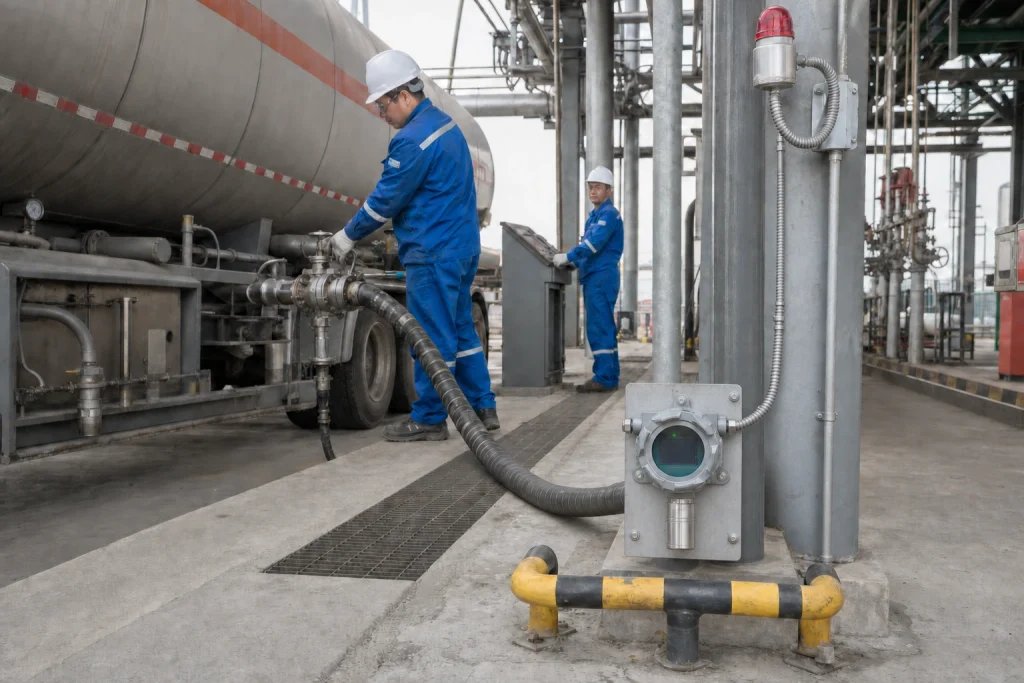
Road tanker racks, rail loading gantries and marine loading arms are statistically busy leak locations because hoses and couplings are connected and disconnected many times per day. They are also where drivers and operators stand closest to the product. Vapor displaced from tank compartments during top loading, drips at coupling points and failures of loading arms all release flammable vapor at working height.
Common practice is to position combustible gas detectors at low level around each loading spot and near drainage channels where spilled product collects. Where sour products or crude are loaded, personal and fixed H2S monitoring are commonly used together, since H2S can reach dangerous concentrations near an open hatch faster than an operator can react to smell alone – and at higher concentrations it deadens the sense of smell entirely. Local audible and visual alarms at the rack itself, not just in the control room, give operators an immediate cue to stop transfer and move away.
Specifying a Refinery Detection Network
When drawing up a specification, a few questions consistently separate a workable system from a problematic one:
- Gas-by-zone mapping. List the realistic release scenarios per area rather than copying a generic gas list; this determines sensor technologies and quantities.
- Mounting height by gas density. Heavy vapors low, hydrogen and methane high, breathing-zone height for toxics where personnel exposure is the concern.
- Alarm architecture. Define low and high alarm actions, relay outputs, and how detector signals reach the DCS or a standalone controller.
- Maintainability. Calibration intervals, sensor replacement procedure and access to detectors at height or inside dikes drive lifetime cost more than purchase price.
- Documentation. Confirm certification coverage for the specific models and regions involved before ordering, since approvals vary by product family and market.
Examples of detector layouts across different industrial settings can be found on our applications page.
Why ASA
ASA supplies fixed gas detectors, dust monitoring instruments and multi-channel alarm controllers covering combustible, toxic and oxygen measurement across a broad range of target gases, which allows a refinery project to source point detection and control hardware from a single product line. Our engineering team supports customers through gas list review, detector count estimation and output configuration during the quotation stage, and responds quickly to technical queries from EPC contractors and end users in Europe and the Middle East. If you are planning or upgrading gas monitoring for a tank farm, process unit or loading facility, contact the ASA team to discuss your requirements.
Disclaimer: Product availability, specifications, measuring ranges, alarm configurations and certification coverage vary by model and region. The information in this article is provided for general reference only and does not constitute a performance guarantee, safety assurance or compliance statement. Always refer to the official product documentation and confirm suitability, certification status and local regulatory requirements with our team before selection, installation or use.