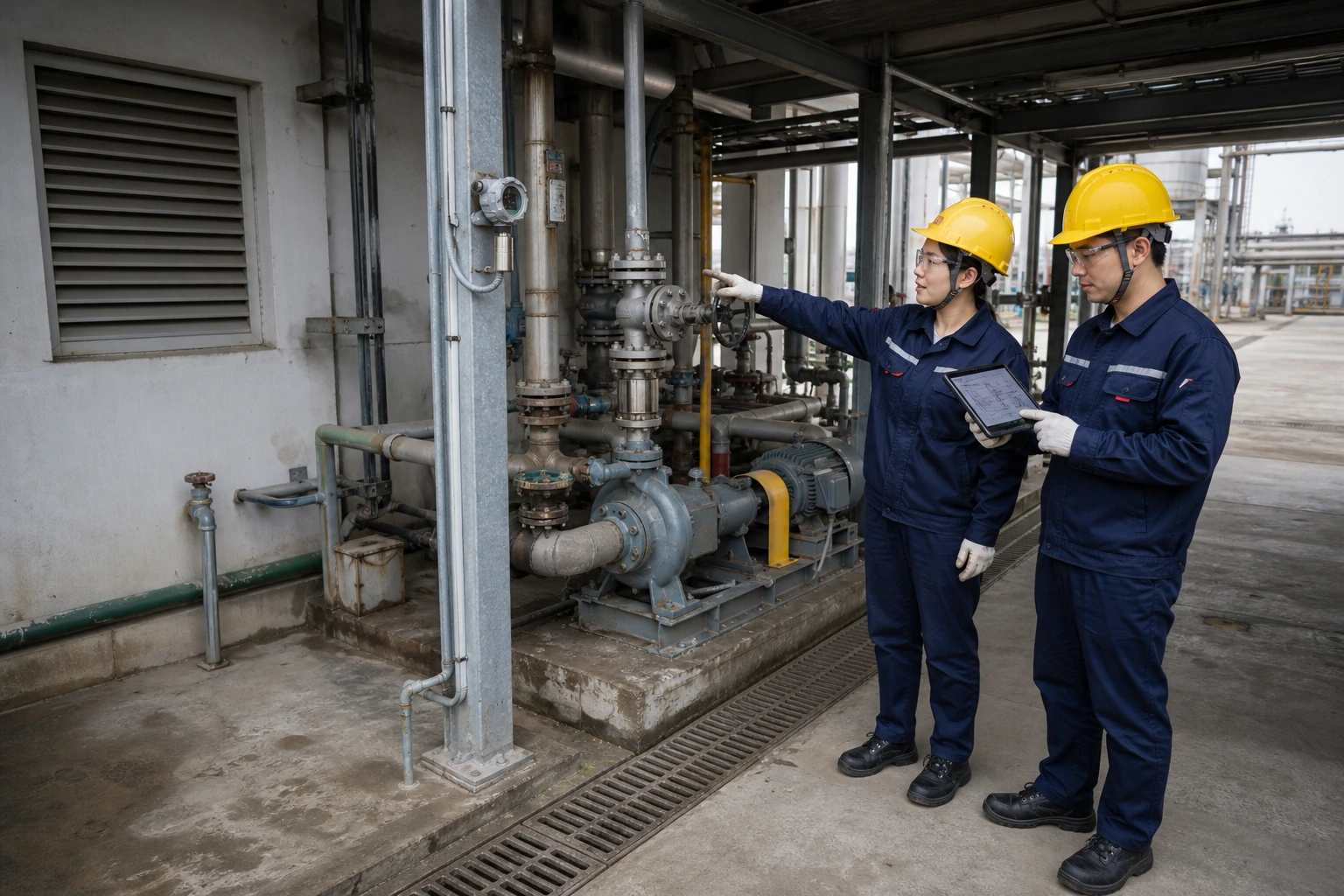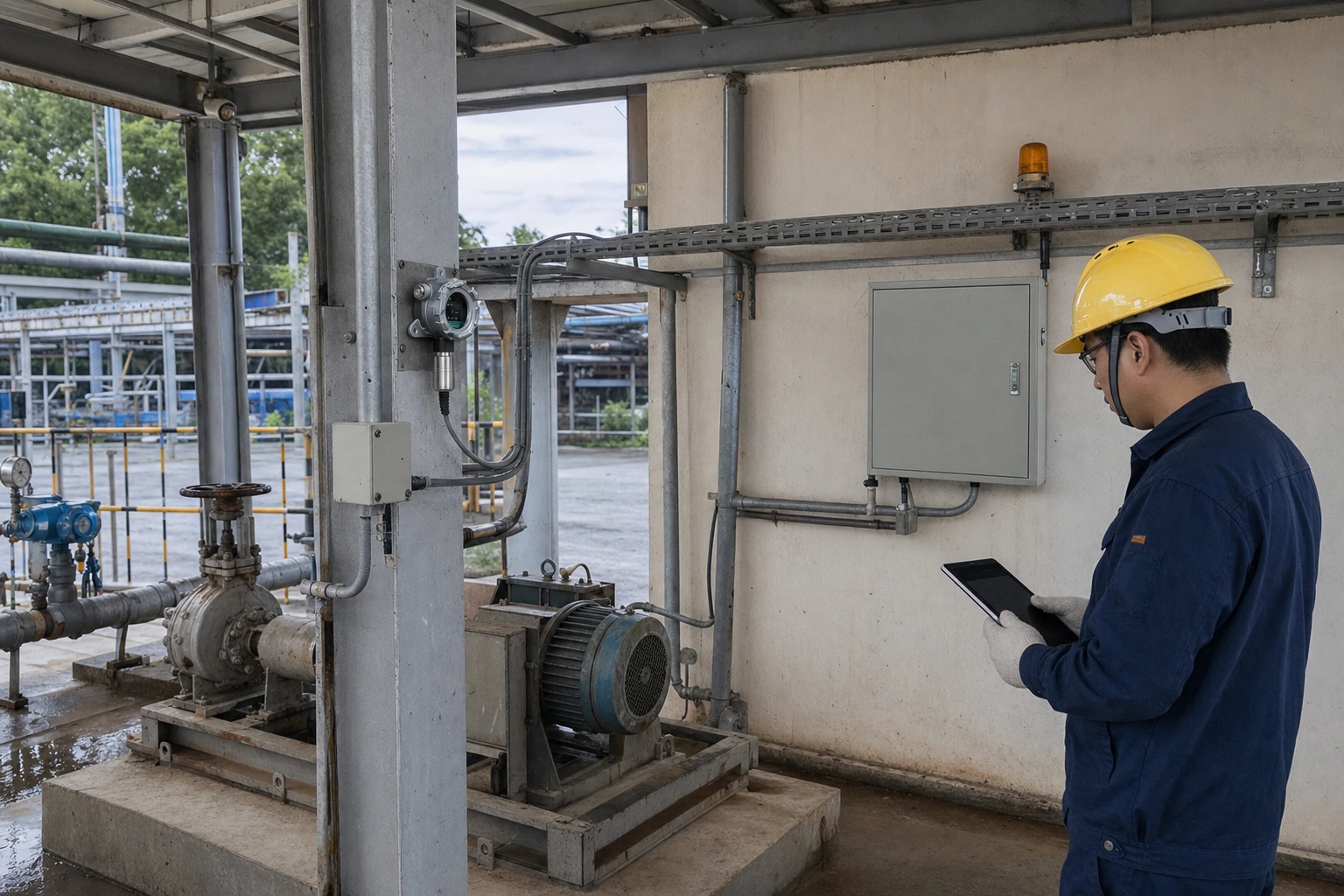
Hydrogen sulfide is one of the most persistent hazards in the water industry, and reliable H2S monitoring in wastewater treatment plants is a core requirement for protecting operators, contractors and visiting engineers. The gas is generated wherever sewage turns septic: in sewers, wet wells, headworks, sludge lines and digesters. Because H2S is both toxic at low concentrations and flammable at high concentrations, plant operators in Europe and the Middle East typically treat it as a priority gas in their fixed detection layout, alongside methane and oxygen depletion. This article outlines where H2S forms in a treatment plant, which exposure values matter, and how fixed detectors and alarm controllers are commonly arranged to cover the risk.
Why H2S Is a Priority Gas in Wastewater Treatment
Hydrogen sulfide (H2S) is produced by sulfate-reducing bacteria under anaerobic conditions, which are common in septic sewage, stagnant wet wells and sludge storage. Several properties make it particularly dangerous in this setting:
- Toxicity at low levels. The ACGIH TLV for H2S is 1 ppm as an 8-hour TWA with a 5 ppm STEL, and a concentration of 100 ppm is considered immediately dangerous to life or health (IDLH) by NIOSH. National occupational limits in Europe and the Middle East vary, so the applicable local value should always be confirmed.
- Olfactory fatigue. The familiar rotten-egg odor is detectable at very low concentrations, but the sense of smell becomes unreliable as concentrations rise, so odor must never be used as a warning method.
- Density. H2S is heavier than air and accumulates in pits, channels, wet wells and other low points, exactly the locations where wastewater personnel need to work.
- Flammability. H2S has a lower explosive limit of about 4.0 percent by volume, so severe accumulations in enclosed spaces can also create an explosion risk.
Because the toxic thresholds are far below the flammable range, H2S detection in wastewater applications is normally specified in ppm using electrochemical sensors, rather than in percent LEL.
High-Risk Areas Across a Treatment Plant
H2S release is not uniform across a site. Fixed-point monitoring is commonly focused on locations where septic conditions and turbulence coincide:
- Headworks and inlet channels. Incoming sewage that has turned septic in long rising mains releases dissolved H2S as soon as it is agitated at screens and grit chambers.
- Wet wells and lift stations. These enclosed, below-grade structures combine anaerobic conditions with poor ventilation and are classic H2S accumulation points.
- Sludge thickening and dewatering areas. Handling, pumping and mechanical dewatering of sludge can release significant H2S, often inside buildings.
- Anaerobic digesters and biogas lines. Digester gas contains H2S alongside methane, so both a toxic H2S detector and a combustible gas detector may be evaluated for digester buildings and biogas handling areas.
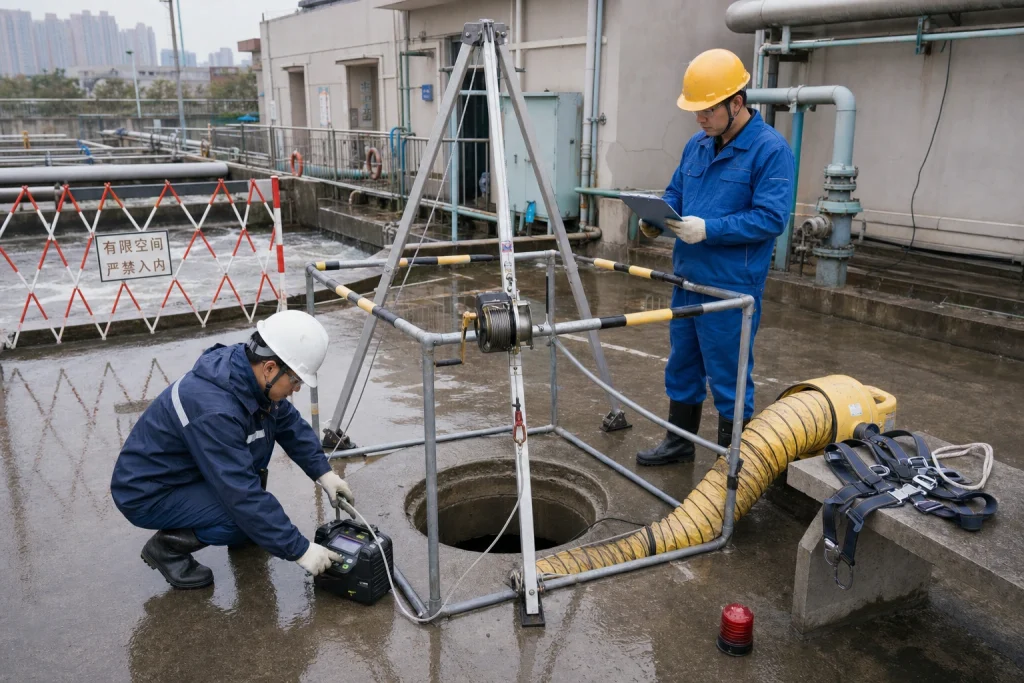
- Confined spaces. Valve chambers, interceptors and tanks taken out of service require pre-entry testing and continuous monitoring under most confined-space entry procedures.
Fixed Detectors, Portables and Alarm Levels
Most wastewater operators use a layered approach. Fixed H2S detectors provide continuous coverage of known release points and alarm before personnel enter an affected area. Portable instruments are then carried for confined-space entry and maintenance work in locations without fixed coverage. Fixed transmitters for this duty are typically electrochemical sensors with a ppm-range measuring scale, mounted low or at breathing height near the expected release point, since the gas tends to sink and spread along floors and channels. A range of suitable fixed gas alarm detectors can be considered depending on the gas range, output signal and environmental protection required.
Alarm setpoints are defined by the site’s safety policy and local regulations. A common practice is to set a low alarm near the applicable occupational exposure limit and a high alarm at a multiple of it, so that the low alarm prompts investigation and the high alarm triggers evacuation, ventilation or shutdown actions. Wastewater environments are humid and often corrosive, so sensor housings, ingress protection and calibration intervals should be reviewed with the supplier for the specific installation point.
Bringing Signals Together with Alarm Controllers
Individual detectors deliver the measurement, but the plant-wide response depends on how those signals are collected. Detectors are commonly wired back to a gas alarm controller using 4-20 mA or RS485 outputs. The controller displays live readings, drives audible and visual alarms, and switches relays that can start fans, close dampers or signal the plant SCADA system. For a treatment plant with several buildings, multi-channel gas alarm controllers allow headworks, sludge buildings and digester areas to be monitored from a single panel in the control room, with relay outputs mapped to the ventilation and alarm strategy of each zone. Redundant power supply and clear zone labelling are practical details that simplify both daily operation and periodic function testing.
Practical Points for Specifying an H2S Monitoring System
When preparing an inquiry or tender for H2S monitoring in a wastewater application, the following information helps a supplier propose a suitable configuration:
- A list of monitoring points with their location type (wet well, headworks, sludge building, digester area) and whether the area is classified as a hazardous zone.
- The required measuring range in ppm and the alarm setpoints defined by the site safety policy.
- The signal interface expected by the control system, such as 4-20 mA, RS485 or relay contacts.
- Environmental conditions, including humidity, temperature range, washdown practices and any known corrosive atmosphere.
- Whether additional gases such as methane or oxygen depletion should be covered by the same controller.
Documenting these points early shortens the technical clarification phase and reduces the risk of ordering detectors that do not match the installation conditions.
Why ASA
ASA supplies fixed gas detectors, dust monitors and gas alarm controllers for industrial buyers across Europe and the Middle East, including water and wastewater applications. Our product line covers toxic gas detection in ppm ranges, combustible gas detection and multi-channel controllers, so a complete monitoring loop can be sourced from one partner. Our engineering team supports point selection, signal integration and documentation during the specification stage, and responds quickly to technical questions during installation and commissioning. If you are planning or upgrading H2S monitoring for a wastewater site, contact our team to discuss your monitoring points and receive a tailored proposal.
Disclaimer: Product availability, specifications, measuring ranges, alarm configurations and certification coverage vary by model and region. The information in this article is provided for general reference only and does not constitute a performance guarantee, safety assurance or compliance statement. Always refer to the official product documentation and confirm suitability, certification status and local regulatory requirements with our team before selection, installation or use.