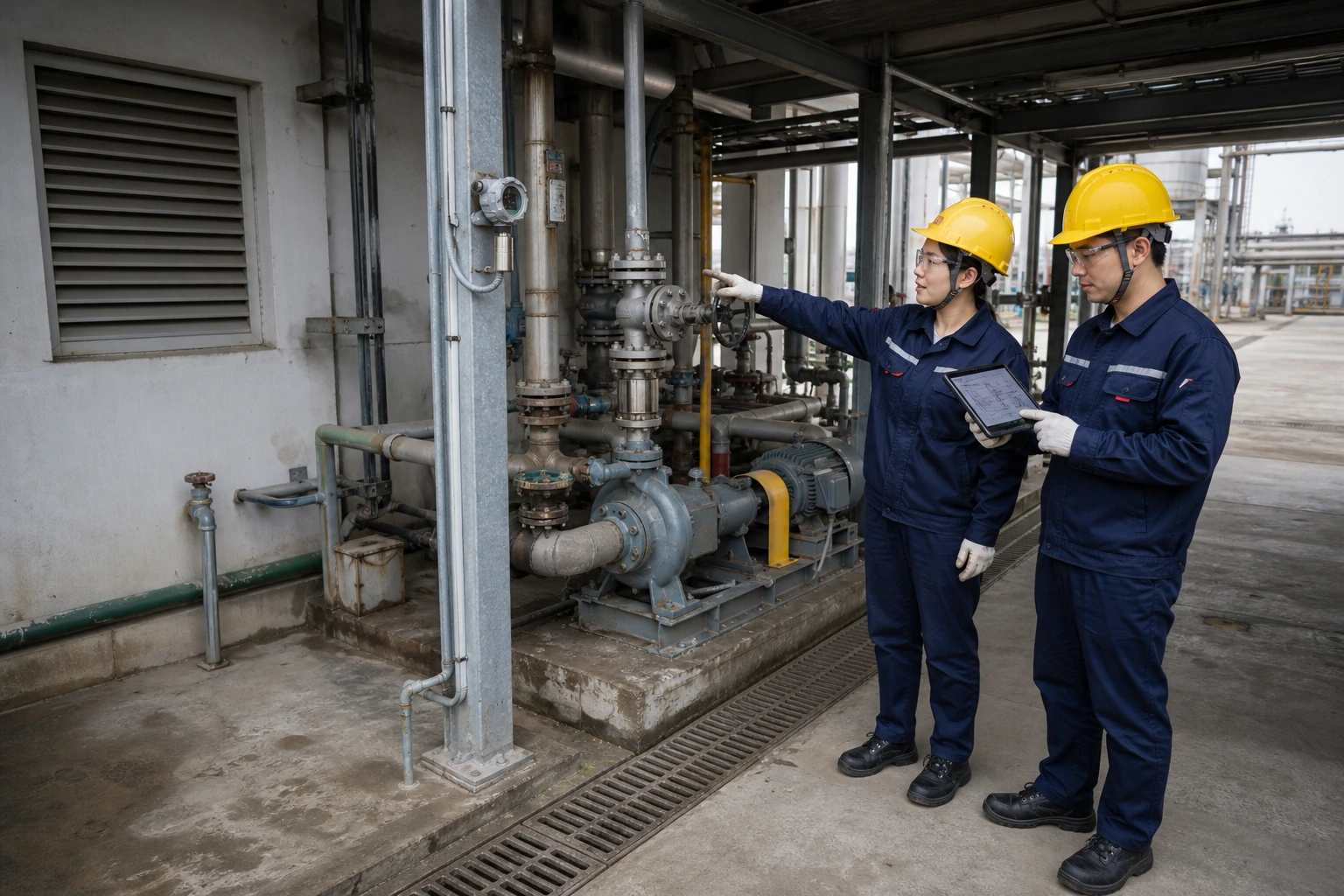
Underground and enclosed car parks concentrate vehicle exhaust in a confined space, and carbon monoxide (CO) is the pollutant that most directly drives their ventilation design. Effective CO monitoring in car park facilities serves two purposes at once: it protects drivers, staff and maintenance personnel from a toxic, odorless gas, and it allows ventilation fans to run only when actually needed, which can reduce energy consumption significantly compared with running fans on a fixed schedule. This article explains why CO accumulates in enclosed parking structures, which exposure limits and alarm thresholds are commonly referenced, and how fixed CO detectors are typically integrated with demand-controlled ventilation.
Why CO Builds Up in Enclosed Car Parks
Carbon monoxide is produced by the incomplete combustion of fuel in petrol and diesel engines. Cold starts, idling in queues at entry and exit ramps, and slow circulation while searching for a space all generate CO at low engine efficiency, precisely the conditions found in a busy car park. Because the space is enclosed, natural dilution is limited, and concentrations can climb during peak periods such as morning arrivals, event lets and evening departures.
CO is colorless and odorless, so occupants receive no sensory warning. Its density is very close to that of air, which means it does not reliably sink to the floor or rise to the ceiling; instead it tends to distribute with air movement patterns in the structure. This behavior has direct consequences for detector placement, discussed below.
Even with the gradual shift toward electric vehicles, most existing car parks will continue to serve combustion-engine traffic for many years, and ventilation codes in most jurisdictions still require CO-based control or monitoring for enclosed parking structures.
Exposure Limits and Typical Alarm Thresholds
Occupational exposure limits for CO vary by jurisdiction. Commonly referenced values include an 8-hour time-weighted average of 20 ppm under the EU indicative occupational exposure limit values (Directive 2017/164), 35 ppm under the NIOSH recommended exposure limit, and 50 ppm under the OSHA permissible exposure limit in the United States. Short-term limits are higher; the EU directive lists 100 ppm as a 15-minute short-term value.
Car park ventilation control does not simply copy these workplace limits. Because parking occupants are transient, national codes and project specifications often define staged thresholds, for example a first ventilation stage in the region of 30 ppm, a boost stage around 60 ppm, and an alarm or warning stage near 100 ppm. These figures vary between countries and projects, so the actual setpoints should always be taken from the applicable local regulation and the project ventilation design. In Europe, EN 50545-1 is a standard commonly referenced by designers for gas detection apparatus used in car parks and tunnels, and it is worth confirming which standard a given project specifies before selecting equipment.
How CO Detectors Drive Demand-Controlled Ventilation
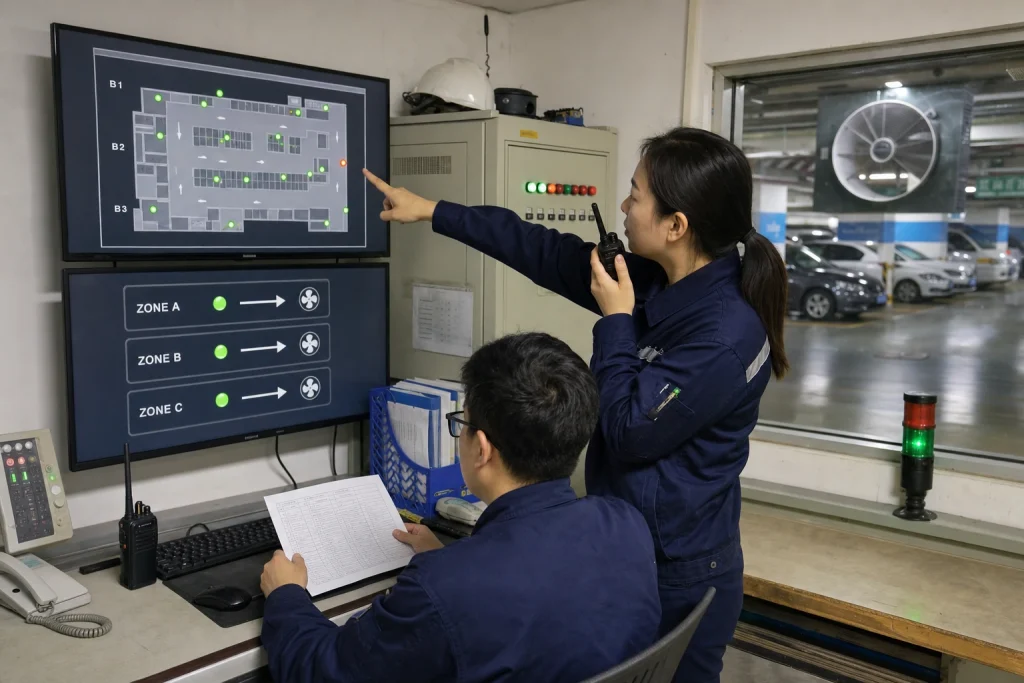
The core idea of demand-controlled ventilation is simple: fixed CO detectors continuously measure gas concentration in each ventilation zone, and a controller uses those readings to switch fans between off, low-speed and high-speed operation, or to modulate variable-speed drives. When the car park is quiet, fans stay off or run at minimum; when traffic peaks and CO rises, ventilation ramps up until concentrations fall back below the recovery threshold.
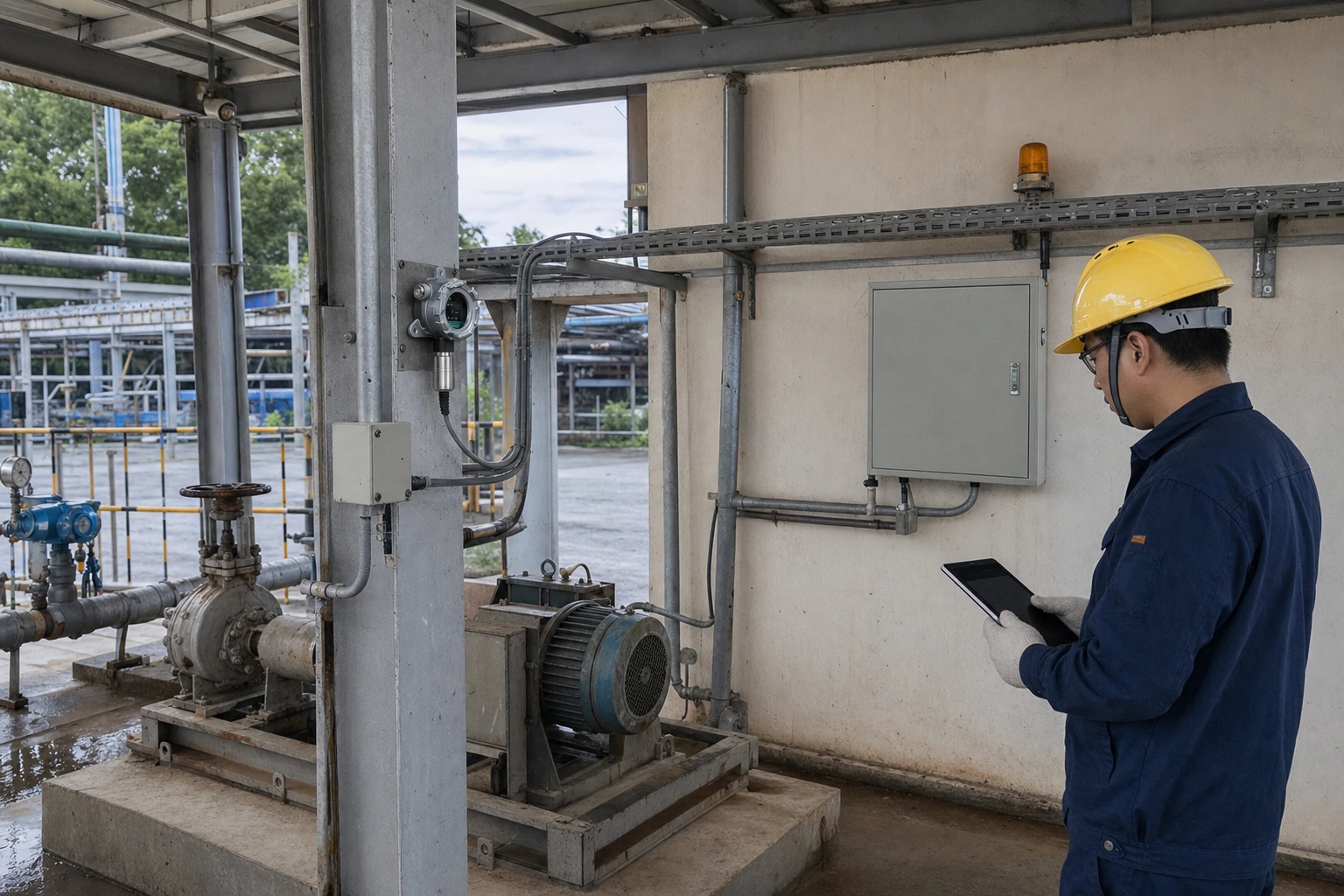
A typical system architecture consists of three layers. First, fixed transmitters such as a fixed carbon monoxide gas detector are distributed across the parking levels, each covering a defined floor area. Second, the detectors report to a central unit such as a gas detection controller, which displays readings, manages alarm levels and provides relay outputs; controllers of this type are intended for installation in non-hazardous (safe) areas such as a plant room or security office. Third, the controller relays or its communication interface hand the signals over to the fan control panel or the building management system, which executes the actual ventilation logic.
Signal transmission between detectors and controller is commonly 4-20mA analog or RS485 digital communication. RS485 bus wiring can be considered for larger car parks with many measuring points, since it reduces cabling compared with individual analog loops, while 4-20mA remains a straightforward choice for smaller installations.
Detector Placement in Parking Structures
Because CO has nearly the same density as air, detectors in car parks are generally mounted in the breathing zone, commonly around 1.5 to 1.8 meters above floor level, rather than at ceiling or floor height. Placement practices that are commonly applied include:
- Dividing each parking level into ventilation zones and providing at least one detector per zone, with typical coverage in the range of a few hundred square meters per point depending on the applicable code and the geometry of the space.
- Positioning detectors near known accumulation points: entry and exit ramps, ticket barriers and payment machines where vehicles idle, and dead-end corners with poor air movement.
- Keeping detectors away from direct airflow from supply fans or open doors, which can dilute local readings and mask real accumulation.
- Mounting units where they are visible for inspection but reasonably protected from vehicle impact and casual damage.
The exact quantity and spacing should follow the local regulation and the ventilation designer’s zoning plan, since national requirements differ. For sites that also house LPG vehicles or charging areas, additional gas types may need to be evaluated separately from the CO system.
Keeping the System Reliable: Calibration and Maintenance
A car park CO system typically runs unattended for years, so a maintenance routine matters as much as the initial design. Electrochemical CO sensors, the technology most commonly used for this application, drift gradually and have a finite service life, so periodic zero and span calibration with certified test gas is standard practice, along with regular bump testing to confirm that each detector still responds and that fan stages and alarms actually trigger. Records of calibration and functional tests are commonly requested during building safety audits, so a simple logbook per site is worth maintaining from day one. Detectors in dusty or damp locations, such as near ramps exposed to weather, may need more frequent inspection of filters and housings.
Why ASA
ASA supplies fixed gas detectors, dust monitors and gas alarm controllers for industrial and commercial facilities, including CO detection points and multi-channel controllers suited to car park ventilation projects. Our product line covers the common toxic and combustible gas targets from a single source, our engineering team supports signal integration questions such as 4-20mA and RS485 wiring toward fan control panels, and we respond quickly to specification requests from consultants and contractors in Europe and the Middle East. To discuss a car park monitoring layout or request documentation, contact our team.
Disclaimer: Product availability, specifications, measuring ranges, alarm configurations and certification coverage vary by model and region. The information in this article is provided for general reference only and does not constitute a performance guarantee, safety assurance or compliance statement. Always refer to the official product documentation and confirm suitability, certification status and local regulatory requirements with our team before selection, installation or use.