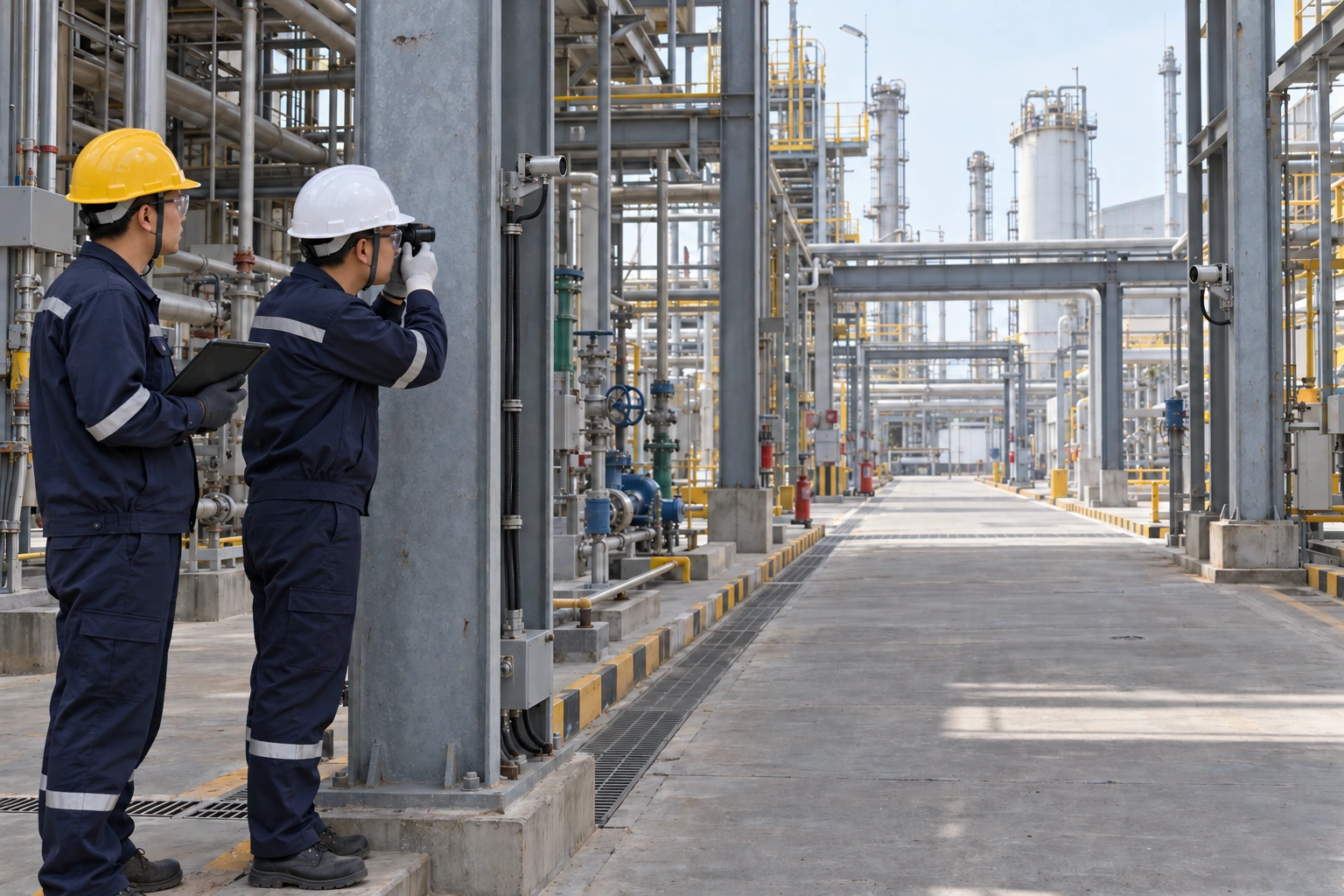
Carbon dioxide is one of the most common gases in industrial and commercial buildings, yet it is also one of the easiest to underestimate. It is colorless, has no meaningful odor at typical concentrations, and is produced continuously by people, combustion processes and fermentation. Effective CO2 monitoring therefore serves two distinct purposes: it acts as a practical indicator of ventilation quality in occupied spaces, and it protects workers from asphyxiation hazards in areas where large volumes of CO2 are produced, stored or handled. This article looks at how CO2 behaves, what concentration levels matter in practice, and how fixed detection is commonly applied in indoor air quality management, breweries and cold chain operations.
Why CO2 Deserves Dedicated Monitoring
CO2 (carbon dioxide) is not flammable and is often dismissed as harmless because it is a normal component of ambient air, present outdoors at roughly 420 ppm. The hazard comes from concentration. CO2 is about 1.5 times heavier than air, so it settles into pits, cellars, tanks and other low or poorly ventilated spaces, where it can displace oxygen without any visible warning.
Widely adopted occupational exposure limits place the 8-hour time-weighted average for CO2 at 5000 ppm (0.5 percent), with short-term limits in the range of 15000 to 30000 ppm depending on the jurisdiction. At higher concentrations, CO2 is not just a simple asphyxiant: elevated levels affect breathing and judgment before oxygen deficiency alone would. This is why relying on an oxygen detector as the only safeguard in CO2-rich areas is generally considered insufficient, and why dedicated CO2 detection based on NDIR (non-dispersive infrared) sensing is the standard approach for this gas.
Indoor Air Quality: CO2 as a Ventilation Indicator
In offices, schools, meeting rooms and production halls, CO2 monitoring is commonly used as a proxy for how well a space is ventilated relative to its occupancy. People exhale CO2 at a fairly predictable rate, so indoor concentration rises when ventilation cannot keep up with the number of occupants. Many indoor air quality guidelines reference values around 1000 ppm as a practical comfort benchmark; readings well above that suggest stale air, reduced concentration and a ventilation system that may be evaluated for adjustment.
Fixed CO2 transmitters with analog or digital outputs can be connected to building or process control systems so that ventilation responds automatically to demand. This demand-controlled approach can be considered where energy cost matters, because it avoids running fans at full speed around the clock while still keeping occupied zones within comfortable limits.
Breweries and Beverage Production
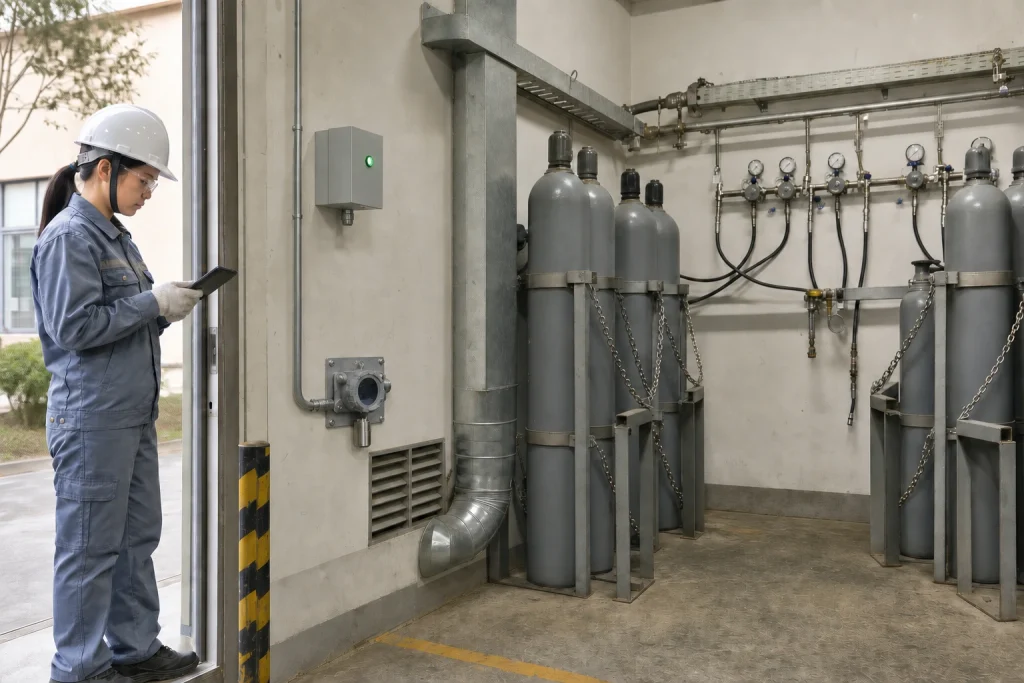
Fermentation converts sugars into alcohol and large volumes of CO2. In breweries, wineries and other beverage plants, the gas is generated in fermentation vessels, released during tank venting, and used again for carbonation and packaging. Cellars, fermentation rooms, tank farms and confined spaces around vessels are the classic risk areas, precisely because CO2 sinks and accumulates at floor level.
Fixed detection in these facilities is commonly arranged with sensing points mounted low, typically within roughly 30 to 150 cm of the floor in areas where CO2 can pool, and near known release points such as vents, filling stations and CO2 storage. Alarm thresholds are often set in two stages, for example a pre-alarm around the occupational exposure limit and a main alarm at a higher level that triggers forced ventilation and instructs personnel to leave the area. A fixed carbon dioxide gas detector installed at these points can provide continuous coverage that portable instruments alone cannot, since the hazard exists whether or not anyone is carrying a device that day.
Cold Chain, Dry Ice and CO2 Refrigeration
The cold chain has become another important area for CO2 monitoring, for two reasons. First, dry ice (solid CO2) is widely used for shipping frozen and temperature-sensitive goods. As it sublimates it releases CO2 gas continuously, so vans, cold rooms and storage areas holding dry ice can reach hazardous concentrations, especially overnight or behind closed doors. Second, CO2 itself (refrigerant R744) is increasingly used as a natural refrigerant in supermarket and industrial refrigeration systems. A leak from such a system releases CO2 directly into machinery rooms or sales areas.
For both cases, fixed detectors in cold rooms, plant rooms and loading areas are commonly linked to local alarms and ventilation. Because a major CO2 release also lowers the oxygen concentration, some operators additionally evaluate an oxygen gas detector for confined or rarely visited spaces, so that both the toxic effect of CO2 and general oxygen depletion are covered. Detector housings and electronics should be specified with the operating temperature range of cold storage in mind, and installation positions chosen so that sensors are not directly exposed to defrost cycles or ice buildup.
Building a Practical CO2 Monitoring Setup
A workable fixed CO2 monitoring system usually comes down to a few decisions: where the gas can realistically accumulate, how many sensing points are needed to cover those locations, what alarm levels and responses are appropriate, and how the detectors report to the wider safety system. NDIR-based transmitters with 4-20 mA or RS485 outputs are the common building blocks, connected to a controller or PLC that handles alarms, relays and ventilation control. For sites that want to see how similar problems are solved elsewhere, our application overview collects typical monitoring scenarios across industries.
Routine care matters as much as the initial layout. CO2 detectors benefit from periodic zero and span checks with certified calibration gas, and from bump testing at intervals defined by site policy. Records of these checks are increasingly expected by auditors and insurers, particularly in food and beverage facilities.
Why ASA
ASA supplies fixed gas detection equipment for industrial buyers in Europe and the Middle East, covering CO2 and a broad range of toxic, combustible and oxygen monitoring needs from a single product line. Our engineering team supports customers through sensor selection, alarm level planning and system integration questions, and we are set up to respond quickly to technical inquiries and quotation requests. If you are planning CO2 monitoring for an indoor space, a brewery or a cold chain facility, contact our team to discuss your requirements.
Disclaimer: Product availability, specifications, measuring ranges, alarm configurations and certification coverage vary by model and region. The information in this article is provided for general reference only and does not constitute a performance guarantee, safety assurance or compliance statement. Always refer to the official product documentation and confirm suitability, certification status and local regulatory requirements with our team before selection, installation or use.