Cold rooms, walk-in freezers and research laboratories share a hazard that is easy to overlook: the air inside them can quietly lose its oxygen. Because oxygen-deficient air looks, smells and feels exactly like normal air, workers get no natural warning before symptoms begin. This is why oxygen depletion monitoring is now treated as a baseline safety measure in facilities that store cryogenic liquids, use CO2 or nitrogen systems, or operate sealed refrigerated spaces. This article explains how oxygen levels drop in these environments, what the physiological risks are, and how fixed oxygen monitors can be specified, installed and maintained to keep enclosed workspaces safe.
How Oxygen Levels Drop in Cold Rooms and Laboratories
Normal atmospheric air contains about 20.9 percent oxygen by volume. In an enclosed space, that figure only falls when something displaces or consumes the oxygen, and cold rooms and labs contain several common sources of displacement:
- Liquid nitrogen and cryogenic gases. Laboratories routinely store liquid nitrogen in dewars for sample preservation. One litre of liquid nitrogen expands to roughly 700 litres of gas at room temperature, so even a modest spill or a slowly venting dewar can displace a significant share of the oxygen in a small, poorly ventilated room.
- CO2 systems. CO2 incubators, dry ice storage and CO2-based processes release carbon dioxide that both displaces oxygen and presents its own toxicity hazard at elevated concentrations.
- Refrigerant leaks. Cold stores and refrigeration plants circulate refrigerants under pressure. A leak inside a sealed, insulated room can accumulate quickly because cold rooms are deliberately built airtight and often have limited ventilation.
- Inerting and purge gases. Nitrogen or argon used for purging equipment, controlled-atmosphere storage or fire suppression can migrate into adjacent enclosed areas.
The common thread is that these spaces are small, tightly sealed and often entered alone. A single person walking into an oxygen-deficient cold room may lose consciousness before recognising that anything is wrong.
Why Low Oxygen Is So Dangerous
Oxygen deficiency is dangerous precisely because the human body has no reliable sensor for it. Occupational safety frameworks in many regions treat atmospheres below 19.5 percent oxygen as oxygen deficient and requiring controls. As concentrations fall further, commonly described effects include impaired coordination and judgement in the mid-teens, rapid fatigue and disorientation below that, and risk of unconsciousness at severely reduced levels. Death can occur quickly in atmospheres where oxygen has been largely displaced by an inert gas.
Two features of these incidents make them particularly severe. First, victims typically collapse without warning, so they cannot self-rescue. Second, would-be rescuers who enter the same space without breathing apparatus frequently become casualties themselves. A wall-mounted or door-mounted oxygen display outside the room, driven by a fixed detector inside, is one of the most direct ways to break this chain, because it warns people before they enter rather than after.
Where to Install Fixed Oxygen Monitors
Placement decisions should reflect which gas is expected to displace the oxygen:
- Nitrogen and helium releases mix readily or rise, so sensors at breathing height (roughly 1.5 m) are a common baseline for general oxygen deficiency monitoring.
- CO2 and argon are heavier than air and tend to pool at low level, so rooms with dry ice, CO2 incubators or argon cylinders often justify low-level sensing in addition to, or instead of, breathing-height placement.
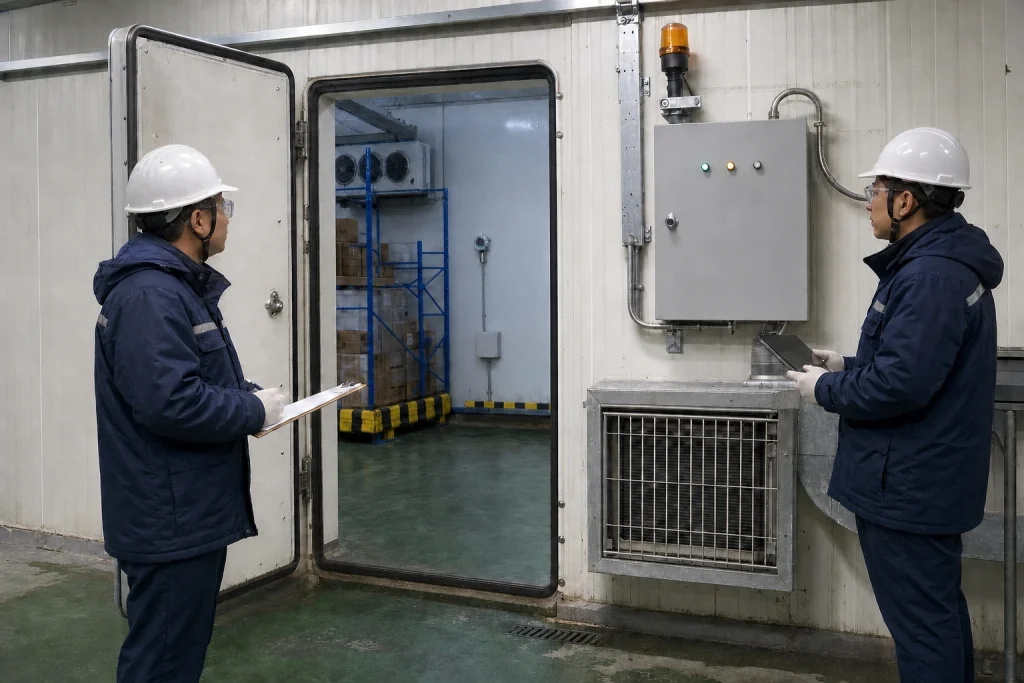
- Cold rooms and freezers benefit from a sensor inside the room paired with a remote display or alarm unit outside the door, so staff can check the atmosphere before entry.
Sensor count depends on room geometry. Long or partitioned rooms, areas with obstructed airflow, and spaces with multiple gas sources may need more than one measuring point. Detectors are typically wired back to a gas detection controller that handles alarm relays, sirens, beacons and interfaces to ventilation systems, so that an alarm can trigger extraction fans automatically as well as alerting personnel. For multi-room laboratories, a multi-channel controller lets one panel supervise several detectors across the facility.
Alarm Setpoints, Calibration and Routine Care
Alarm thresholds should follow your local regulations and site risk assessment. In practice, many sites configure a first alarm around 19.5 percent oxygen to prompt investigation and ventilation, and a second, more urgent alarm at a lower level to require evacuation and controlled entry procedures. Some applications also use a high-oxygen alarm, since oxygen enrichment above about 23.5 percent increases fire risk in areas where oxygen cylinders or oxygen-generating processes are present.
Electrochemical oxygen sensors, the most common technology in fixed monitors, deplete gradually over time and are affected by temperature, which matters in freezer applications. A sustainable maintenance routine generally includes periodic bump testing to confirm the sensor responds, scheduled calibration against a known reference, and sensor replacement at the interval recommended for the specific product. Cold-room installations should also confirm the detector’s rated operating temperature range against the actual room temperature before selection.
Selecting Equipment for Cold Rooms and Labs
For fixed-point installation, a dedicated fixed oxygen O2 gas detector such as the ASA AN-O2-D can be considered as the measuring element, wired to a local alarm or a central controller. The AN-O2-D carries the China Ex Certificate EETI24.0463X (Ex db IIC T6 Gb, IP65), which may be relevant where site policy calls for flameproof construction. Facilities that also run CO2 incubators or dry ice storage may be evaluated for parallel CO2 sensing with a carbon dioxide CO2 gas detector, since CO2 becomes hazardous at concentrations well below those that produce a measurable oxygen drop. Where the project covers several rooms or mixed gas hazards, browsing the wider application overview can help map detector types to each area before requesting a formal proposal.
Why ASA
ASA supplies fixed gas detectors, dust monitors and gas alarm controllers covering oxygen, toxic and combustible gas applications from a single product line, which simplifies sourcing for multi-hazard sites such as laboratories and cold-chain facilities. Our engineering team supports detector selection, placement review and controller configuration during the quotation stage, and our response times are structured around the procurement schedules of industrial buyers in Europe and the Middle East. If you are planning oxygen depletion monitoring for a cold room, freezer complex or laboratory, contact our team for a specification review and quotation.
Disclaimer: Product availability, specifications, measuring ranges, alarm configurations and certification coverage vary by model and region. The information in this article is provided for general reference only and does not constitute a performance guarantee, safety assurance or compliance statement. Always refer to the official product documentation and confirm suitability, certification status and local regulatory requirements with our team before selection, installation or use.