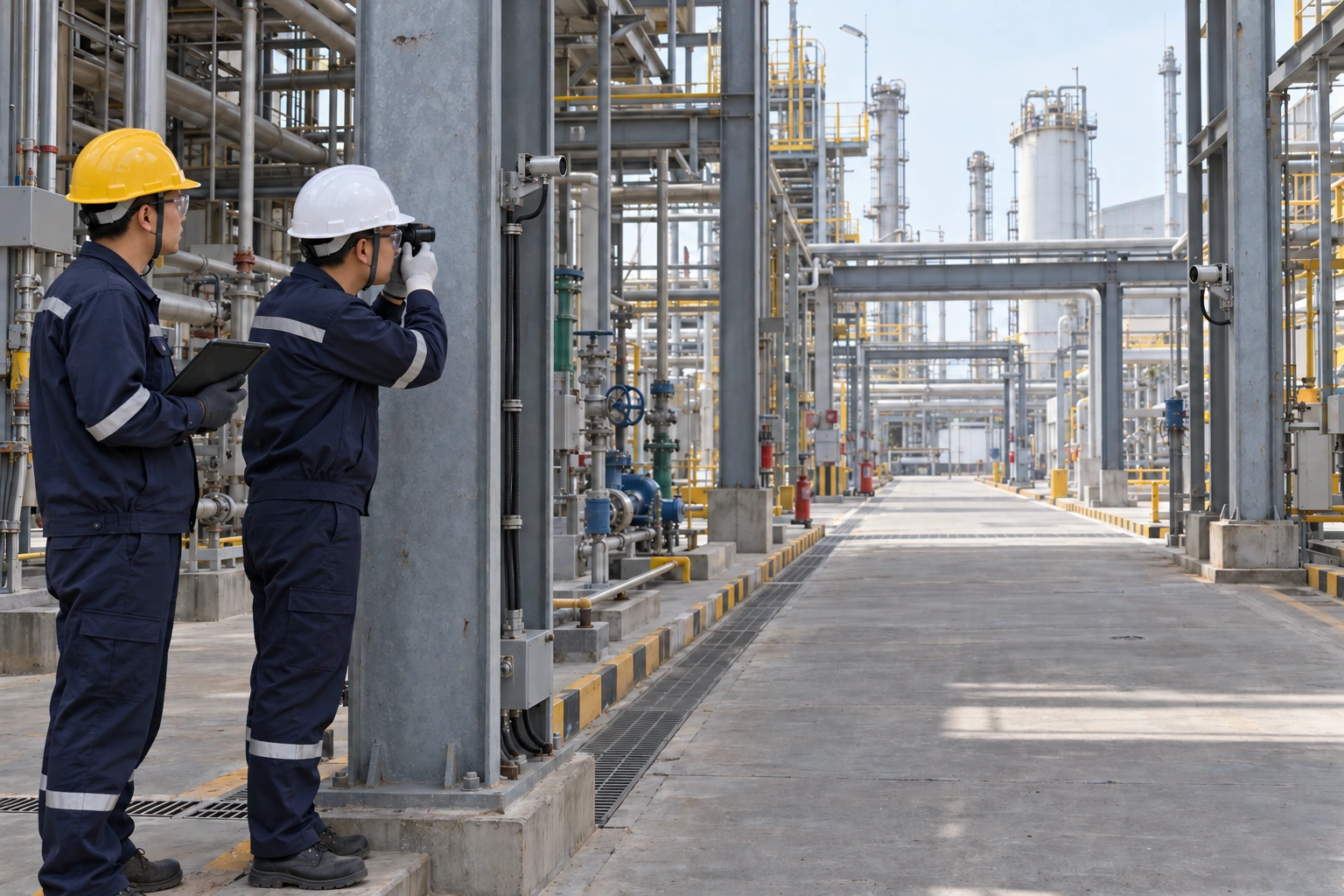
When a specification calls for equipment that measures toxic gases and vapours, the European reference that usually appears is the EN 45544 toxic gas series. It is the standard family that describes how electrical apparatus for the direct detection and direct concentration measurement of toxic gases and vapours should be tested, what influences must be accounted for, and how instruments are grouped by intended use. For buyers in industrial safety, the practical value is not the standard number on a datasheet but the way the series separates devices intended for readings near occupational exposure limits from devices intended for much higher concentrations. Getting that distinction right at the specification stage avoids a common and expensive mismatch later.
What EN 45544 Covers – and What It Does Not
EN 45544 applies to apparatus that detects and measures the concentration of toxic gases and vapours directly, which in practice means fixed and transportable electrical instruments using sensors that respond to the target gas itself rather than to a sampled and laboratory-analysed medium. Its scope is deliberately narrow. Oxygen measurement and flammable gas measurement are addressed by separate European standards, so an instrument that measures oxygen deficiency or combustible gas in percent LEL is assessed against a different document even if it sits in the same enclosure or reports to the same controller.
Two further boundaries are worth noting. First, EN 45544 is a performance standard, not an explosion protection standard. Suitability for a classified hazardous area is a separate question governed by its own certification route, and the two should never be treated as interchangeable. Second, the standard governs the measuring function of the apparatus. It does not decide where detectors should be placed in your plant, how many are needed, or what alarm thresholds your site should adopt – those remain engineering decisions informed by your own risk assessment and local regulation.
The Structure of the Series
The series is published in parts, and a specification that simply says “to EN 45544” without a part number is incomplete. Broadly, the parts divide as follows.
Part 1 sets out the general requirements and test methods. This is where the influence quantities live: the effects of temperature, humidity and pressure variation, the treatment of cross-sensitivity to interfering gases, response and recovery behaviour, warm-up, stability over time, and the documentation an instrument must carry. Every other part builds on it.
Part 2 contains performance requirements for apparatus used to measure concentrations in the region of limit values – in other words, instruments whose readings will be compared against occupational exposure limits such as time-weighted averages and short-term exposure limits.
Part 3 contains performance requirements for apparatus used to measure concentrations well above limit values, where the measurement supports decisions about escalating hazard rather than routine exposure assessment.
Part 4 is a guide to selection, installation, use and maintenance. It is the part most often overlooked by buyers, and the part that most directly shapes whether an installed system keeps performing after the first year.
Editions of the parts have been revised at different times. Always confirm which edition your specification or client contract cites, because test requirements and terminology are not identical across revisions.

Performance Classes in Practice: Near the Limit or Well Above It
The split between Part 2 and Part 3 is the core idea a purchaser needs to carry away. An instrument judged against Part 2 is expected to be accurate enough that a reading close to an exposure limit can be trusted to support a decision about whether workers are within that limit. That is a demanding requirement, because the measurement uncertainty must stay small relative to a small number, and it must stay small while temperature, humidity and interfering gases move around it.
An instrument judged against Part 3 works in a different regime. Once a concentration is far above the exposure limit, the decision is usually evacuate, ventilate or isolate, and it does not hinge on whether the display reads 180 or 200 units. Requirements are therefore framed around reliable indication across a wide range rather than tight uncertainty at the low end.
Problems arise when the two are confused. A wide-range instrument selected for a leak detection duty may be entirely appropriate for alarm purposes yet unsuitable for demonstrating compliance with an exposure limit. The reverse also happens: a sensitive low-range instrument specified for a duty where large releases are credible may saturate or need frequent replacement. Clarifying the intended use first, and only then choosing the measuring range, is the discipline the standard encourages.
Turning This Into a Workable Specification
A specification that is useful to both sides usually answers four questions. Which gas or gases, and at what concentrations do decisions actually change? Is the duty exposure assessment, leak alarm, or both – and if both, does that justify separate devices? What are the real ambient conditions, including temperature swing, humidity and known interfering substances on site? And what maintenance regime, including bump testing and calibration intervals, will be funded once the system is live?
Those answers drive sensor choice more than any brochure does. Electrochemical sensing is commonly used for gases such as hydrogen sulphide and carbon monoxide at the concentrations where exposure limits sit, and may be evaluated against Part 2 style duties; a fixed H2S detector for confined space and process areas or a fixed CO monitoring point in enclosed workshops are typical starting points. Where several gases and several duties coexist across a site, it is usually more productive to review the full range of fixed gas alarm detectors against a consolidated point list than to specify each location in isolation.
One caution on documentation. Compliance with a performance standard is shown by test evidence for a specific model and configuration, not by a general statement in marketing material. If a part of EN 45544 is contractual for your project, ask for the documentation covering the exact model number, gas and range you intend to buy.
Why ASA
ASA supplies a coordinated product line of fixed gas detectors, dust alarm detectors and gas alarm controllers, so a multi-gas site can be covered from one source with consistent wiring practice and one point of contact for support. Our engineering team works with customers on detector point lists, range selection and controller architecture before an order is placed, so the specified equipment matches the duty. Because we manufacture and stock our core detector models, quotation and lead times stay short when a project scope changes late, and documentation questions are answered directly by our technical staff.
If you are preparing a toxic gas detection specification and want a second opinion on ranges, sensor selection or controller layout, talk to the ASA team with your gas list and site conditions, and we will come back with a concrete proposal.
Disclaimer: Product availability, specifications, measuring ranges, alarm configurations and certification coverage vary by model and region. The information in this article is provided for general reference only and does not constitute a performance guarantee, safety assurance or compliance statement. Always refer to the official product documentation and confirm suitability, certification status and local regulatory requirements with our team before selection, installation or use.