For industrial buyers, catalytic sensor poisoning is a maintenance and selection issue that deserves attention before a combustible gas detector is installed. A detector can remain powered while its sensing element loses sensitivity. Understanding the chemicals used around the installation helps procurement, maintenance and safety teams ask better questions about sensor suitability, verification and replacement. The discussion below concerns catalytic bead technology in general; it does not establish the sensing principle or performance of any specific ASA model.
How contamination changes the measurement
A catalytic bead sensor measures the heat released when combustible gas oxidizes on an active element. Contamination can interfere with that reaction, reducing the signal produced by a given gas concentration. Poisoning describes lasting damage, while inhibition may be reversible under conditions specified by the manufacturer. The distinction cannot be established simply by watching a display return to zero. Honeywell explains these mechanisms in its technical note on LEL sensor poisons.
A useful purchasing question is therefore: how will the site demonstrate that the detector still responds to gas after foreseeable chemical exposure? A power indicator, communications signal or apparently normal reading does not answer that question. The project specification should identify who owns this verification task, which instructions apply and what happens when a detector fails its checks.
Silicones, lead and sulfur compounds
Silicone-containing sealants, lubricants and mold-release products can introduce contaminants near a sensor. Lead compounds are also recognized catalyst poisons. Sulfur compounds can inhibit or damage catalytic elements, with the outcome depending on the substance and exposure. Honeywell’s technical note cautions that poisoning and inhibition can overlap. Avoid treating every sulfur exposure as temporary or assuming that clean air will restore a damaged element.
Exposure can occur during servicing or storage as well as normal production. Industrial Scientific’s guide to sensor poisons and inhibitors highlights contamination from nearby sprays and products that release vapors. A maintenance workshop or equipment locker therefore deserves the same attention as the detector location.
For a practical site review, ask each department to list the materials it brings into the area. Include contractors performing sealing, lubrication and cleaning work. Review safety data sheets and seek manufacturer clarification when compatibility is unclear. A purchasing label such as general-purpose lubricant provides too little information to establish compatibility with a sensing element.
Make chemical substitutions part of change control. A new cleaning agent may be approved for the process equipment while still requiring a separate review for the gas detection system. Record the material, where it will be used, who reviewed it and whether additional detector checks are needed. This creates a traceable decision instead of relying on informal familiarity with a product name.
Verification after suspected exposure
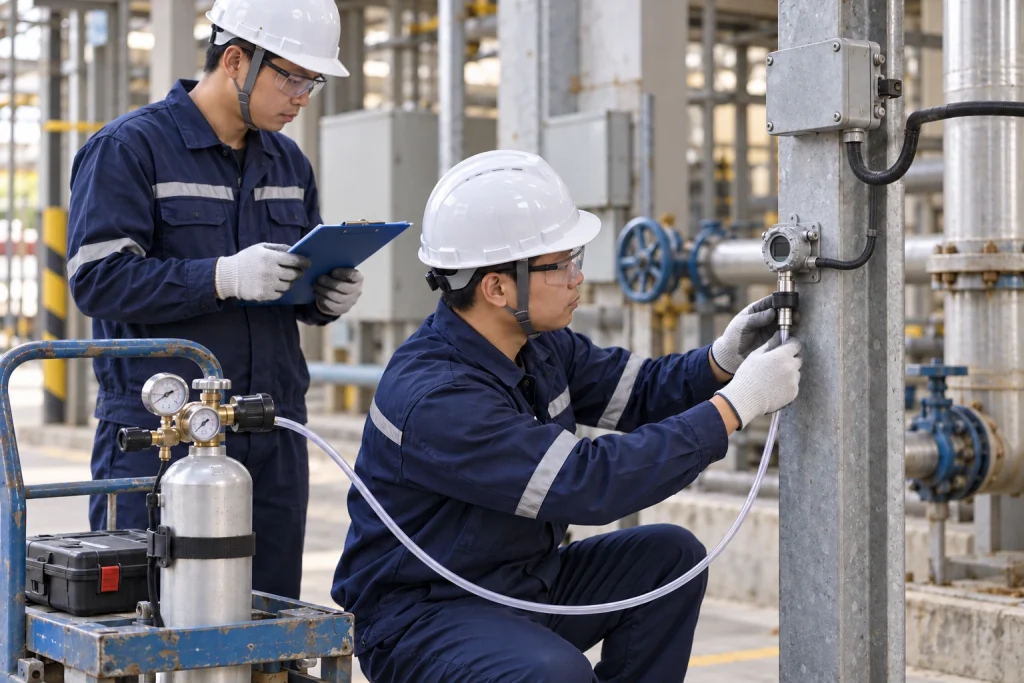
A functional gas test and a calibration serve different purposes. A bump test checks response and alarm operation; it does not establish measurement accuracy. A calibration check compares the response with a known gas concentration, while calibration adjusts the instrument as specified by its manufacturer. OSHA explains these distinctions in its guidance on testing portable gas monitors. That guidance addresses portable equipment and should not be treated as a universal service schedule for fixed installations.
For a fixed detector, follow its own manual and the site’s approved maintenance procedure. After suspected contamination, have competent personnel assess the instrument before relying on it. Use the prescribed gas, delivery accessories and acceptance criteria. If verification fails, maintain the site’s required alternative protective arrangements while the cause is investigated and the detector is serviced or replaced.
Build the maintenance record around evidence: detector identity, location, suspected exposure, test gas details, measured response, corrective action and authorization to return to service. Record unsuccessful checks as well as successful ones. A history of repeated sensitivity loss can help the team identify a recurring contamination source that a replacement sensor alone would leave unresolved.
Do not create an improvised recovery procedure using solvents, heating or unapproved gas exposure. Ask the manufacturer to define acceptable recovery checks and replacement criteria. The work order should also address how alarm outputs and any temporary maintenance overrides will be checked and restored under the site’s procedure.
Turn the exposure review into a purchase specification
Start with a written description of the target combustible gases and the surrounding process. Add routine and occasional chemicals, maintenance activities, environmental conditions and access constraints. Ask suppliers to explain how the proposed sensing technology fits that description and to identify limitations in writing. A general claim of poison resistance needs model-specific supporting documentation and a clear account of what it does not cover.
For projects involving methane, ASA’s methane gas alarm detector may be evaluated as a starting point for a product inquiry. Confirm the supplied sensor technology and chemical compatibility directly with the team. The product name alone should not be used to infer resistance to silicones, lead or sulfur compounds.
Compare proposals on maintainability as well as purchase price. Request the relevant manuals, replacement arrangements, test accessories and service responsibilities. Ask how the proposed installation allows technicians to perform the required checks. For European and Middle Eastern projects, include the destination and site requirements in the inquiry so that documentation and suitability can be reviewed for the actual application.
Why ASA
ASA covers gas detectors, dust alarm detectors and gas alarm controllers, giving procurement teams a starting point for discussing related monitoring needs. Bring the exposure review and maintenance expectations into the engineering discussion early. Ask the team to clarify product selection, documentation and support arrangements against the project scope, including the response schedule needed for technical questions.
To discuss an application, contact ASA with your gas detection requirements. Include the target gases, possible contaminants, installation conditions and planned verification procedure so the inquiry can focus on suitability and maintainability.
Disclaimer: Product availability, specifications, measuring ranges, alarm configurations and certification coverage vary by model and region. The information in this article is provided for general reference only and does not constitute a performance guarantee, safety assurance or compliance statement. Always refer to the official product documentation and confirm suitability, certification status and local regulatory requirements with our team before selection, installation or use.